Colour or Color? How British and American Spelling Split
Write "colour" in an American office or "color" in a British classroom and someone will reach for a red pen. Yet both spellings are correct. They're the legacy of two dictionary makers, one revolution, and a long argument about whether spelling should honour a word's history or match how it sounds.
The split wasn't an accident. It came from political independence, deliberate reform, and the enormous reach of one American schoolbook. Here is how it happened, which famous "rules" are actually myths, and how to keep your own writing consistent.
Before the split: spelling was a free-for-all
For most of its history, English had no fixed spelling. Writers spelled words the way they heard them, printers adjusted words to fit a line, and the same word could appear three ways on one page. Even Shakespeare's name survives in several spellings.
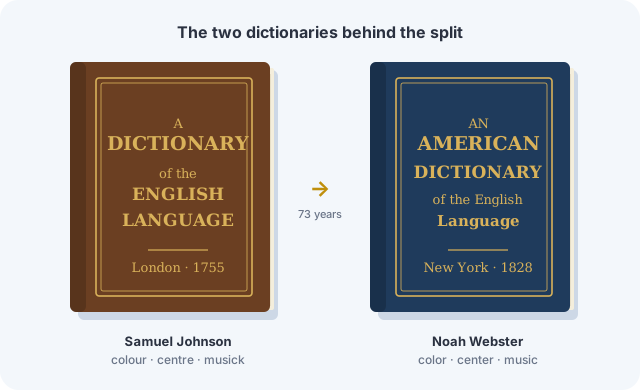
That began to change in 1755, when Samuel Johnson published A Dictionary of the English Language in London, with over 40,000 entries. Johnson generally preferred spellings that showed where a word came from. He kept the French-style endings in honour, colour and centre, and he also kept forms that look odd today, such as musick and publick. His dictionary became the authority on both sides of the Atlantic, at least for a while.
Noah Webster's spelling revolution
After the American Revolution, a Connecticut schoolteacher named Noah Webster argued that a new nation needed its own standard of language. "As an independent nation," he wrote in 1789, "our honor requires us to have a system of our own, in language as well as government."
Webster's most powerful tool wasn't a dictionary at all. His spelling book, first published in 1783 and nicknamed the "Blue-Backed Speller", taught generations of American children to read and sold tens of millions of copies. Whatever spellings it used, American schools used too.
He followed it with A Compendious Dictionary of the English Language in 1806 and, in 1828, An American Dictionary of the English Language, with about 70,000 entries, far more than Johnson's.
What Webster changed
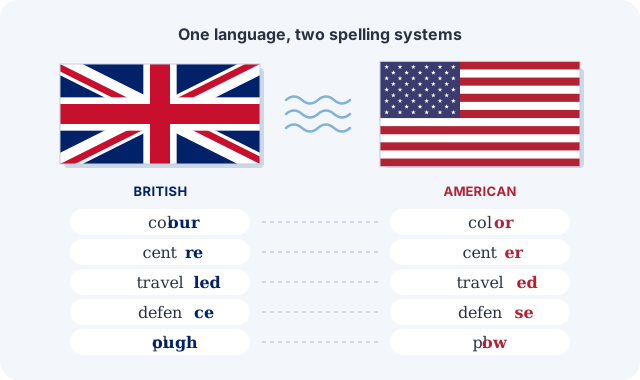
Webster's goal was spelling that matched pronunciation and dropped letters that did no work. These are the changes that stuck in American English:
| Pattern | British | American |
|---|---|---|
| -our → -or | colour, honour, neighbour | color, honor, neighbor |
| -re → -er | centre, theatre, metre | center, theater, meter |
| -ce → -se | defence, offence, licence (noun) | defense, offense, license |
| Single L before a suffix | travelled, cancelled, modelling | traveled, canceled, modeling |
| Silent letters dropped | plough, draught (of air) | plow, draft |
Some of his simplifications won on both sides of the Atlantic. Johnson's musick and publick became music and public everywhere, and British English still uses draft for a first version of a document while keeping draught for beer and cold air.
Not really. The -ize ending comes from Greek, and it was used in Britain long before Webster; a British dictionary spelled realize with a z in 1721. In 1884 the Oxford English Dictionary chose to list -ize first, and Oxford University Press still uses it, a style known as "Oxford spelling". The -ise form grew popular in Britain during the 1800s, partly through French influence, and is now the more common British choice, but organize is perfectly correct British English. The one true difference is in words like analyse and paralyse, which keep the "s" in Britain even in Oxford spelling.
The reforms that didn't stick
Webster also had ideas America rejected. He proposed tung for "tongue" and wimmen for "women", defending the latter as "the old and true spelling". Neither caught on.
The reform urge didn't end with him. In 1906, the steel magnate Andrew Carnegie funded a Simplified Spelling Board, and President Theodore Roosevelt ordered the government printer to use its list of 300 simplified words, such as altho, thoro and fixt. Congress objected, the House voted to withhold printing money for documents in the new spelling, and Roosevelt dropped the order within months. In the 1930s the Chicago Tribune tried its own "sane spelling" with words such as agast and burocracy, then quietly let most of them go.
Those failures show something important: spelling changes stick when schools and dictionaries adopt them, not when someone simply announces them.
Why Britain kept the older spellings
Britain had no reason to follow an American reformer. Johnson's dictionary remained the reference, and keeping a word's French or Latin shape was seen as respect for its history. The great Oxford English Dictionary, published in parts from 1884 and completed in 1928, recorded those spellings in enormous detail and fixed them as the British standard. The rest of the Commonwealth, from Australia to India and South Africa, largely followed Britain.
Did printers and telegraphs drive the split?
It's often said that American printers and newspapers adopted Webster's shorter spellings to save ink, metal type and paper, and that the telegraph rewarded shorter words. There may be some truth in the printing part, but it wasn't the main force. Telegrams were generally charged by the word, not by the letter, so writing "color" instead of "colour" saved nothing on the wire. The real engine was education: generations of Americans learned to spell from Webster's books.
The exceptions that break the rules
- Americans write glamour, keeping the "u", and glamor is rare.
- British English drops the "u" too in humorous, honorary and laborious, even though it keeps it in humour, honour and labour.
- Australia's Labor Party uses the American spelling in its name, although Australians otherwise write labour.
- Canada mixes both systems: colour and centre as in Britain, but often -ize and tire as in the United States.
How computers spread American spelling
In the 20th century, American companies built much of the world's computing, and their spelling came with it. Web designers in London still write color and text-align: center in CSS, because that's how the language was defined. For years many programs shipped with US English as the default spell-check language, quietly flagging "colour" as an error on British computers. Most British and Commonwealth publishers, schools and governments still keep British spelling.
Which spelling should you use?
Both are correct. What matters is choosing one and sticking to it:
- Follow your audience. Writing for US readers? Use American spelling. For the UK, Ireland, Australia, New Zealand or South Africa, use British.
- Follow the style guide of the publication, school or company you write for. Some British publishers use Oxford -ize spelling.
- Be consistent. Mixing "color" and "colour" in one document looks like a mistake, even if each one is correct on its own.
A quick consistency check: paste your text into our Frequency Analyzer and scan the word list for pairs like color and colour, or organize and organise. If both show up, you've mixed systems. If you're writing to a strict length limit, the Word & Character Counter shows how much the extra letters add up.
Quick reference: common British and American spellings
| British | American |
|---|---|
| colour, flavour, favourite | color, flavor, favorite |
| centre, fibre, litre | center, fiber, liter |
| defence, licence (noun), pretence | defense, license, pretense |
| travelled, jewellery, counsellor | traveled, jewelry, counselor |
| analyse, paralyse | analyze, paralyze |
| catalogue, dialogue | catalog (catalogue also used), dialogue |
| grey, tyre, cheque | gray, tire, check |
| aluminium | aluminum |
Mixed "colour" and "color" by accident?
Paste your text into the Frequency Analyzer to see every word you used and how often. Mixed spellings stand out right away.
Open the Frequency Analyzer →Frequently asked questions
Why do Americans spell "color" without a "u"?
Because of Noah Webster. In the late 1700s and early 1800s, his spelling book and dictionaries dropped letters he considered unnecessary, turning "colour" into "color" and "honour" into "honor". American schools taught from his books, so his spellings became the national standard.
Is "-ize" American spelling?
Not exclusively. The -ize ending is older than American English and is used in Oxford spelling. British writers today more often use -ise, but both are accepted in the UK. Americans use -ize almost always.
Who was Noah Webster?
An American teacher and lexicographer (1758–1843) who wrote the best-selling "Blue-Backed Speller" and the 1828 American Dictionary of the English Language. His work established most of the differences between American and British spelling.
Should I use British or American spelling?
Use the spelling your readers expect, or the one your publisher's style guide requires, and stay consistent throughout the document.