From Stone to Screen: A 5,000-Year History of Writing
Every message you type sits at the end of a very long chain. Writing began as marks carved into rock and pressed into wet clay, heavy and permanent and stuck in one place. Over five thousand years it moved to lighter, cheaper, faster materials: reed paper, animal skin, rag paper, printed pages, and finally text with no physical weight at all.
Each new material changed more than how writing looked. It changed who could read, how fast ideas traveled, and even basic features we now take for granted, such as spaces between words and the difference between capital and small letters.
The ancient world: stone, clay and papyrus
Clay tablets and cuneiform (from c. 3200 BCE)
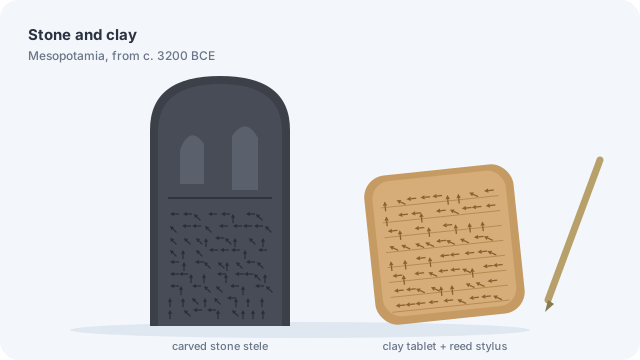
The first full writing system we know of appeared in Sumer, in southern Mesopotamia (modern Iraq). Scribes pressed the cut end of a reed into soft clay, leaving wedge-shaped marks known as cuneiform, from the Latin for "wedge". The earliest tablets are mostly accounts, recording grain, sheep and beer rations. Writing began as bookkeeping.
Sun-dried tablets could be soaked and reused, while baked ones became almost indestructible. Hundreds of thousands have survived, many of them hardened by accident when the libraries holding them burned down.
Carved stone
For words meant to last forever, rulers used stone. A stele is a carved stone slab set up in public. The most famous, the Code of Hammurabi (c. 1754 BCE), records nearly 300 laws on a block of black stone over two meters tall. Stone was public, permanent and very hard to forge, but you couldn't exactly carry it in your pocket.
Papyrus (from c. 2900 BCE)
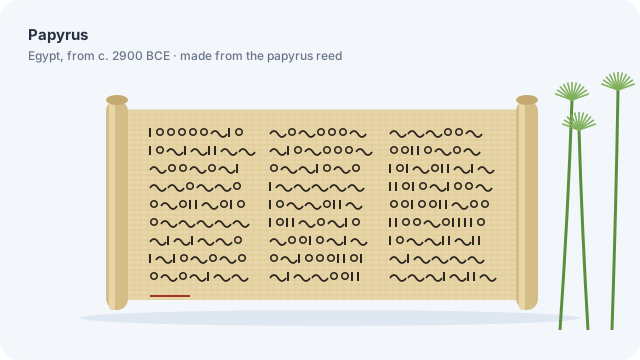
The Egyptians found a lighter answer growing along the Nile. To make papyrus, they cut the reed's pith into thin strips, laid one layer across another at right angles, then pressed and dried the sheet until the plant's own sap bonded it. Sheets were glued end to end into rolls that could stretch for meters. The oldest blank papyrus roll found so far dates to around 2900 BCE.
Papyrus was light and portable, ideal for running an empire. Its weakness was moisture: outside Egypt's dry climate it rotted, which is why so much ancient writing from elsewhere is lost.
Wax tablets: the first notepad
Greek and Roman students and merchants did their everyday writing on wax tablets: wooden boards coated with a thin layer of beeswax. They scratched letters with a pointed stylus and wiped the wax smooth with its flat end to erase. It was the ancient world's notepad, and the first writing surface with a real "undo".
Parchment, the codex and paper
Parchment
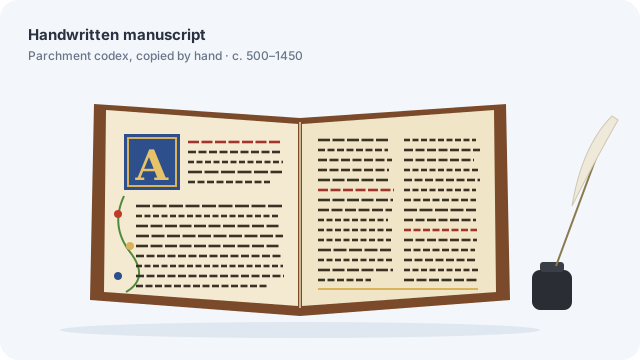
Parchment is animal skin, usually sheep, goat or calf, soaked, scraped and dried under tension. (Vellum is the finest kind, made from calfskin.) A popular story credits its invention to the city of Pergamon in the 2nd century BCE, after Egypt cut off its papyrus supply, but skins were used for writing long before that. Parchment was far tougher than papyrus, could be written on both sides, and could even be scraped clean and reused.
The codex: the book as we know it
Between the 1st and 4th centuries CE, scrolls gave way to the codex: sheets folded and stitched along one edge, with covers. Readers no longer had to unroll several meters to find a passage. They could flip straight to a page, write on both sides, and carry a whole library of texts in one volume. By the 4th century the codex dominated, and it is still the shape of every book you own.
How scribes gave us spaces and lowercase letters
Many classical Latin texts were written as scriptio continua, a continuous stream of capital letters with no gaps: READINGWASHARDWORK. Readers sounded words out, often aloud. In the late 7th century, Irish monks copying Latin, a foreign language for them, began separating words with spaces. By the 11th century, word spacing was normal across northern Europe. Every time you tidy up a paragraph in our Whitespace Cleaner, you're maintaining their invention.
Around the year 800, scribes at Charlemagne's court developed a clear, rounded script called Carolingian minuscule. Its small letters are the direct ancestors of today's lowercase, while the older Roman capitals became our uppercase. Our Case Converter switches between two alphabets more than a thousand years old.
Paper
Paper came from China. Tradition credits Cai Lun, an official at the Han court, who in 105 CE presented a refined method using tree bark, hemp, old rags and fishing nets. Archaeologists have since found Chinese paper from a century or two earlier, so Cai Lun improved and standardized paper rather than inventing it. Either way, paper was smooth and far cheaper than skins.
Papermaking spread west along the trade routes, reaching Samarkand and then Baghdad, where mills were running by the late 8th century. Cheap paper fueled the libraries, translations and scholarship of the Islamic Golden Age, and from there it reached Spain and Italy, and by the late Middle Ages most of Europe.
The print era
Movable type and the printing press (c. 1440)
Printing from carved wooden blocks was common in East Asia for centuries, and the idea of movable type came from there too. In China, Bi Sheng made movable type from baked clay around 1040, and in Korea the Jikji of 1377 is the oldest surviving book printed with movable metal type.
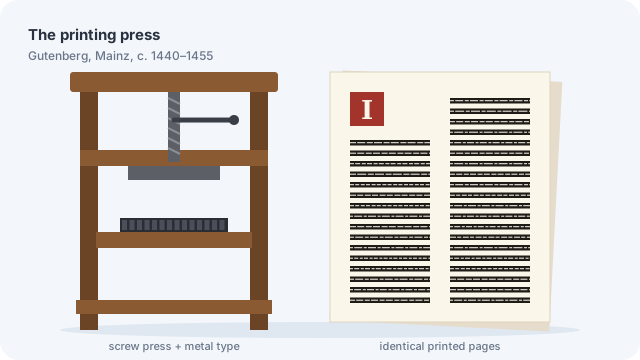
In Europe, Johannes Gutenberg of Mainz brought together several pieces around 1440: metal type that could be cast quickly and in identical copies, an oil-based ink that stuck to metal, and a screw press adapted from wine and paper making. His Bible was finished around 1455. A scribe might copy a few books a year; a print shop could produce hundreds of identical copies. Prices fell, literacy spread, and spelling and grammar slowly began to standardize because thousands of readers now saw the same page.
Steam presses and wood-pulp paper (1800s)
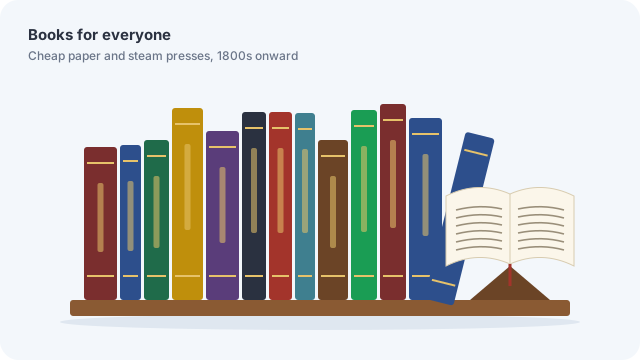
The Industrial Revolution turned printing from a craft into an industry. Steam-powered presses, first used by The Times of London in 1814, printed far faster than hand presses. From the 1840s, paper made from wood pulp replaced expensive rag paper. Together they made daily newspapers, cheap novels, magazines and mountains of office paperwork possible.
Typewriters (1870s)
The typewriter put a small printing press on every office desk and gave us the QWERTY layout we still type on. We tell that story in full in From Typebars to Touchscreens: The History of the Keyboard.
The digital era: text becomes data
Word processors (1970s–1990s)
With computers, text detached from any surface. Letters became numbers (bytes) stored on magnetic disks and drawn on screens on demand. Word processors let writers delete, move and rewrite freely, the wax tablet's "undo" reborn without limits. It also made text measurable: a computer can count words, sort lines or find repeats instantly, which is exactly what tools like our Word & Character Counter and Frequency Analyzer do.
The web (1990s)
In 1989, Tim Berners-Lee, a scientist at CERN, proposed a system of linked documents; by 1991 the World Wide Web was public. Using HTML and HTTP, any page could link to any other, and text stopped being a straight line from first page to last. Anyone with a connection could now publish to the world.
The cloud and collaboration (2000s–today)
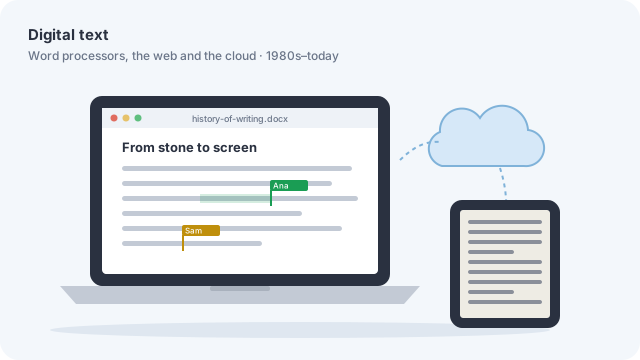
Online editors such as Google Docs, launched in 2006, moved documents from a single computer to remote servers. Several people can now edit the same text at once, from a phone, tablet or laptop, with every change saved automatically.
Writing materials at a glance
| Medium | From | Strength | Weakness |
|---|---|---|---|
| Clay tablet | c. 3200 BCE | Cheap; nearly indestructible once baked | Heavy and bulky |
| Stone | Ancient world | Permanent and public | Can't be moved or edited |
| Papyrus | c. 2900 BCE | Light; rolls into scrolls | Rots in damp climates |
| Wax tablet | Greek and Roman era | Reusable; erasable | Temporary by design |
| Parchment | Before 200 BCE | Tough; both sides usable | Expensive (animal skins) |
| Paper | China, by 105 CE | Cheap and smooth | Took centuries to spread |
| Printed page | c. 1440 in Europe | Identical copies at scale | Fixed once printed |
| Digital text | 1970s–80s | Editable, searchable, instant to share | Depends on devices and formats |
The future of writing
- Writing with AI. Writing is shifting from typing every word to describing what you want. A person outlines the ideas, an AI drafts and restructures, and the person edits and decides. The skill moves from producing sentences to judging them.
- Writing without keys. Wristbands that read muscle signals, brain-computer interfaces and eye-tracking glasses are early steps toward turning intention into text without a keyboard at all.
- Text that adapts to its reader. Documents may soon adjust themselves: simplifying for a beginner, expanding for an expert, translating on the fly, or adding a diagram where a reader gets stuck.

Across all of it, one pattern holds. Each new medium made writing lighter, cheaper and easier to copy, and each time, more people got to read and write. Clay recorded the grain harvest for a few trained scribes; today, billions of people write every day without a second thought.
Five thousand years in, text is still text
Count it, clean it, convert it or analyse it with our free tools. Everything runs in your browser, and your text never leaves your device.
Explore all text tools →Frequently asked questions
What was the first writing material?
Clay. The earliest full writing system, Sumerian cuneiform, was pressed into clay tablets in Mesopotamia around 3200 BCE. Writing on stone and on papyrus followed soon after.
What is the difference between papyrus and parchment?
Papyrus is made from a plant, the papyrus reed of the Nile, while parchment is made from processed animal skin. Parchment is stronger, lasts longer in damp climates, and can be written on both sides.
Who invented paper?
Paper was invented in China. Cai Lun is traditionally credited with it in 105 CE, but archaeologists have found older Chinese paper, so he is better described as the official who refined and standardized it.
When did people start putting spaces between words?
Irish monks began separating words in Latin manuscripts in the late 7th century. Before that, many Latin texts were written without spaces, a style called scriptio continua.