Six Dots That Changed Reading: The History of Braille
In 1824 a fifteen-year-old blind student in Paris finished a code that let blind people read and write for themselves. Two centuries later, his six dots are on lift buttons, medicine boxes and electronic displays.
Louis Braille did not invent tactile reading; he improved on two earlier ideas. Here is how his system came together, why his own school tried to ban it, and how braille moved from paper to pins.
Before braille: books of raised letters
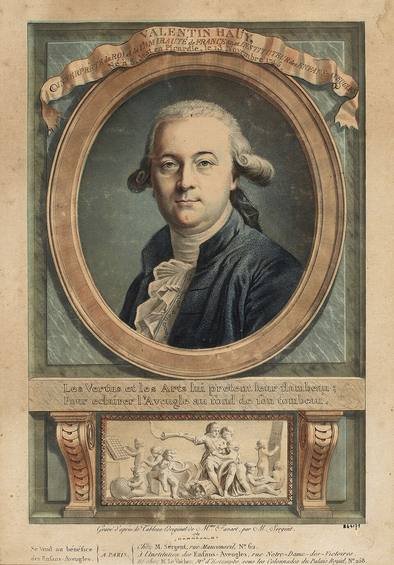
In 1784 Valentin Haüy, a French language teacher, began teaching a blind boy named François Lesueur to read using letters pressed into thick paper so they stood up in relief. Lesueur learned fast, and in 1785 Haüy opened a school for blind children in Paris, the Institution des jeunes aveugles. It became a "royal" institution in 1786, and today it is the Institut National des Jeunes Aveugles.
Haüy's books were a breakthrough, but ordinary letters are hard to tell apart by touch, so reading meant slowly tracing each curve. The books were huge and expensive, and pupils could not easily write in the same form.
Charles Barbier's point writing
Charles Barbier took a different approach. Instead of copying print, he used patterns of raised dots punched into paper. His system, described in an 1815 book, used cells of up to 12 dots in two columns of six, and each cell stood for one of 36 French sounds, not letters. Barbier offered it to the Paris school, and in 1821 the new director, Alexandre-René Pignier, had it demonstrated to the pupils.
Not quite. Barbier's code is often called "night writing," and many accounts say it was designed so soldiers could read orders in the dark, sometimes for Napoleon's army. Researchers at the Perkins School for the Blind found no evidence for this: Barbier served in the artillery before the Revolution but never rejoined, and his 1815 book presents the system for blind readers. The soldier story seems to have appeared about a century after Braille's death.
A boy from Coupvray
Louis Braille was born on 4 January 1809 in Coupvray, a village east of Paris. His father made harnesses and saddles. At the age of three, playing in the workshop, Louis injured one eye with an awl, a pointed tool for piercing leather. The infection spread to the other eye, and by about the age of five he was completely blind.
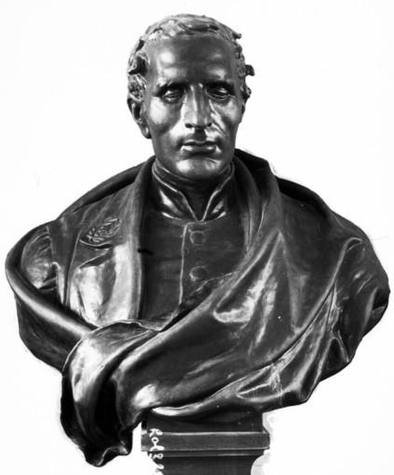
In February 1819, aged ten, he won a place at the Paris institution, where he learned to read Haüy's slow raised-letter books.
From twelve dots to six (1821–1824)
Braille was twelve when Barbier's system reached the school. He saw its promise and its flaws: a 12-dot cell was too tall to feel in one touch, and a code of sounds could not show spelling, punctuation, numbers or music.
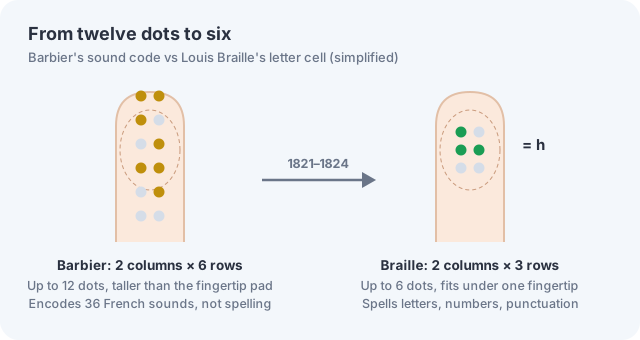
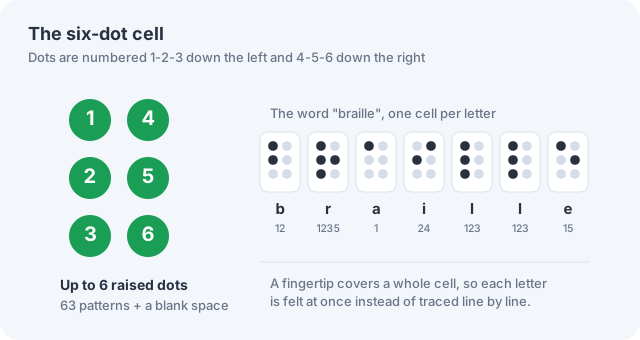
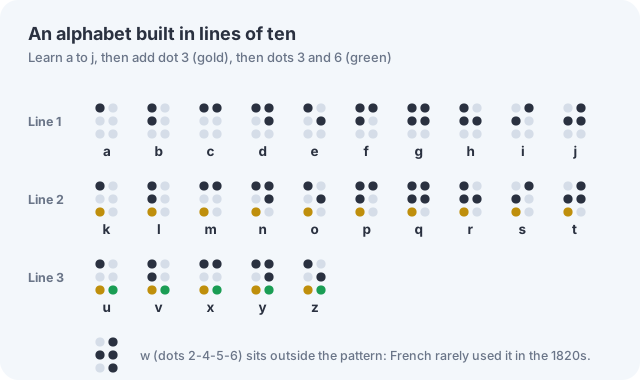
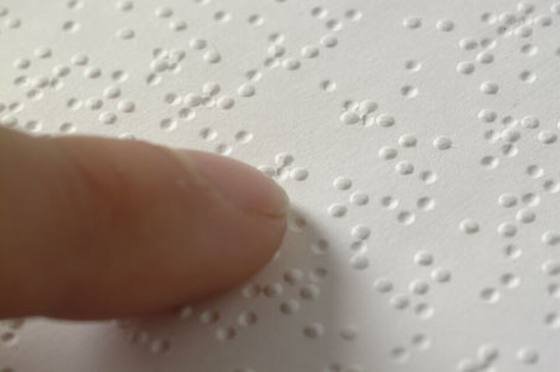
Over three years Braille cut the cell to six dots in two columns of three, small enough to read under one fingertip, with each cell standing for a letter. In 1824, aged fifteen, he presented it to his classmates and to Pignier.
Six dots give 63 patterns. Braille built the alphabet in lines of ten, adding dots to the first line to make the next, and the cells for a to j double as the digits 1 to 0 after a number sign.
The 1829 book and the 1837 edition
In 1829 Braille published his system as Procédé pour écrire les paroles, la musique et le plain-chant au moyen de points, "Method of writing words, music and plainsong by means of dots, for use by the blind." It already included numbers, punctuation and musical notation. Braille was a skilled cellist and organist, and music was part of the plan from the start.
The first version still mixed dots with dashes. Pupils found the dashes hard to tell from pairs of dots, so the 1837 second edition dropped them. That edition is essentially French braille as it is still used today. By then Braille was teaching at the institution himself, where he became a full professor in 1833.
Banned at its own school
Braille's classmates loved the code, but many sighted teachers preferred raised Roman letters, which they could read without learning a new system.
In 1840 Pignier was forced out, and the new director, Pierre-Armand Dufau, banned the use of braille at the school except for music. He also destroyed the stock of books his predecessors had made. These are often described as "burned braille books," but they were actually books in Haüy-style raised letters made under earlier directors. Dufau brought in his own raised-letter books instead. Pupils kept writing braille in secret.
The turning point came in 1844, at the opening of the school's new building on the boulevard des Invalides. Dufau's assistant, Joseph Guadet, who had become convinced of braille's value, gave a public demonstration on 22 February 1844. One pupil wrote down a poem dictated by a visitor, then a second pupil, who had been sent out of the room, came back and read it aloud from the braille page. Braille returned to the classroom.
Louis Braille did not live to see his code officially recognized. He suffered for years from a respiratory illness, long believed to be tuberculosis, and died on 6 January 1852, two days after his 43rd birthday. In 1854 the institution formally adopted his system. In 1952, a century after his death, his remains were moved to the Panthéon in Paris; his hands were kept in Coupvray.
The "War of the Dots"
Braille spread across Europe, but in the United States rival systems fought for decades to become the standard, a struggle nicknamed the "War of the Dots."
The first American rival was not a dot code at all. Boston Line Type, introduced in 1835 by Samuel Gridley Howe of the Perkins Institution, was an angular form of raised Roman letters. The real dot rivals came later: New York Point, published in 1868 by William Bell Wait, used cells two dots high and of varying width, and American Braille, devised by Joel W. Smith of Perkins around 1878, kept Braille's six-dot cell but reassigned letters so the most common ones took the fewest dots. British readers, meanwhile, used braille much closer to the French original.
In 1917 the United States settled on a compromise called Revised Braille Grade One and a Half. Then, in 1932, representatives of the English-speaking world met in London and agreed on Standard English Braille, based on British contracted braille. It ended the war, but not every difference: British and American rules for layout and technical material kept drifting apart.
| Year | Event |
|---|---|
| 1784–1785 | Valentin Haüy teaches with raised letters and opens his Paris school for blind children |
| 1815 | Charles Barbier publishes his 12-dot sound-based point writing |
| 1821 | Barbier's system is demonstrated at the Paris school; Louis Braille is 12 |
| 1824 | Braille, aged 15, presents his six-dot system |
| 1829 | First published description of braille, including music |
| 1837 | Second edition drops dashes; essentially modern French braille |
| 1840–1844 | Braille banned by director Dufau, then reinstated after Guadet's demonstration |
| 1852 | Louis Braille dies in Paris, aged 43 |
| 1854 | The Paris institution officially adopts braille |
| 1868–1878 | New York Point and American Braille compete in the US |
| 1932 | Standard English Braille agreed in London |
| 1976 | An early refreshable braille device, the Digicassette, is introduced in Paris |
| 2004 | Unified English Braille declared complete |
| 2016 | The United States completes its switch to UEB |
One English code: Unified English Braille
By the late 20th century, English braille still had separate codes for literature, mathematics and computer text. In 1991 the Braille Authority of North America began work on a single code, and the International Council on English Braille took the project over in 1993. Unified English Braille (UEB) was declared complete in 2004.
Countries adopted it at their own pace: Australia in 2005, the United Kingdom in 2011, and the United States, which voted for UEB in 2012 and completed the change on 4 January 2016, Louis Braille's birthday. UEB covers literary and technical text in one system, though the US still also uses the separate Nemeth code for much mathematics. UEB marks a capital letter with dot 6, an idea that may sound familiar if you have read about how the alphabet got two sets of letters.
From paper to pins
For most of its history, braille meant dots pressed into paper with a slate and stylus, a braille writer or an embosser. Engineers experimented with electronic braille from the 1950s, and in 1976 Oleg and Andie Tretiakoff introduced the Digicassette in Paris, an early paperless braille device.
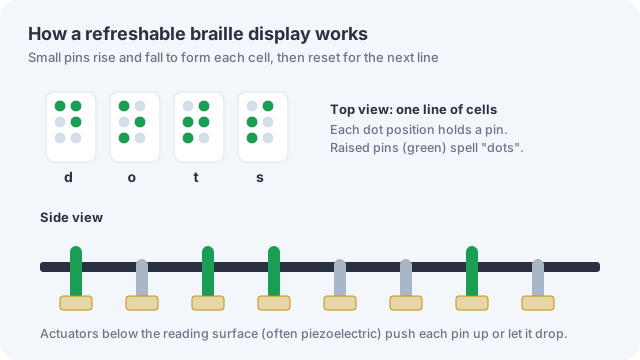
A refreshable braille display has small pins, one for each dot position, raised and lowered by actuators (usually piezoelectric) to show a line of text from a computer or phone. Most show a single line of 14 to 80 cells. Newer multi-line devices go further: the Monarch, developed by the American Printing House for the Blind and HumanWare, shows 10 lines of 32 cells and can display tactile graphics such as diagrams and charts alongside braille text.
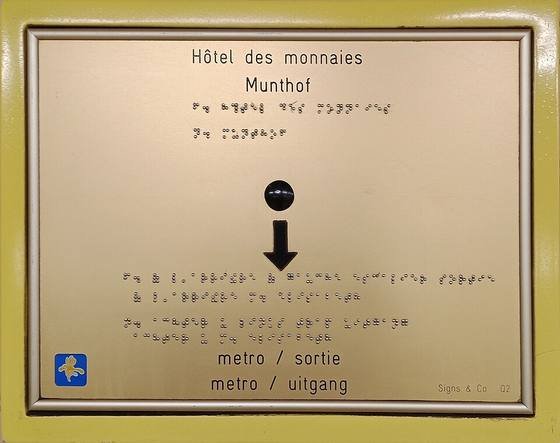
Braille also appears on everyday objects: EU medicine packs must carry the product name in braille, and many lift buttons and signs include it. The United Nations has marked 4 January as World Braille Day since 2019.
Why braille still matters
Screen readers and audiobooks help, but listening is not reading. Braille lets blind readers check spelling and layout, read music and code, and write independently, just as a teenager in Paris intended. It belongs to the wider story of how people encode text, from clay tablets to keyboards to the dots and dashes of Morse code.
Write your name in braille
Type any text into our free Braille Translator to see it in six-dot cells, read braille back as text, or tap out cells with the dot keypad. It supports English (UEB), French and Spanish braille.
Open the Braille Translator →Frequently asked questions
Who invented braille?
Louis Braille, a blind French student at the Paris school for blind children. He adapted Charles Barbier's 12-dot point writing into a six-dot cell, presented it in 1824 at the age of 15 and published it in 1829.
Was braille invented for soldiers?
No. A popular story says Barbier designed "night writing" for soldiers, but there is no evidence the army used it, and his 1815 book presents it for blind people.
When was braille officially adopted?
The Paris institution officially adopted braille in 1854, two years after Louis Braille's death. English-speaking countries agreed on Standard English Braille in 1932 and later moved to Unified English Braille.
How does a refreshable braille display work?
Small pins, one per dot position, are raised and lowered to form braille cells showing text from a computer or phone.
Sources
- Louis Braille Invents His Code, American Foundation for the Blind
- Braille Recognized, American Foundation for the Blind
- Louis Braille, Charles Barbier, and the making of a myth, Perkins School for the Blind
- Blindness History Basics: The War on the Dots, American Printing House for the Blind
- Unified English Braille (UEB), RNIB
- A Brief History of the Refreshable Braille Display, American Printing House for the Blind