Dots, Dashes and a Single Wire: The History of Morse Code
In 1844 a message travelled 40 miles from Washington to Baltimore almost instantly. It was spelled out in short and long pulses of electricity, and the code behind it is still in use today.
Morse code was the first widely used way to turn text into signals. It began with a painter's idea on a ship, needed a mechanic's skill to work, and was later reshaped by a German engineer into the version the world adopted. Here is how it happened, what changed along the way, and where you can still hear it.
Before electricity: towers and arms
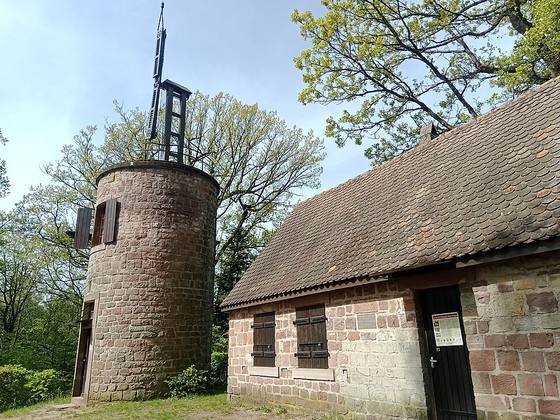
Long-distance signalling existed before the electric telegraph. In the 1790s the French engineer Claude Chappe built a network of hilltop towers with movable wooden arms. An operator set the arms into a position, the next tower copied it through a telescope, and messages crossed France far faster than a rider could carry them. The first line, between Paris and Lille, opened in 1794.
These optical telegraphs had obvious limits. They needed a chain of staffed towers within sight of each other, and they stopped working at night and in fog or heavy rain.
Early electric telegraphs
After Alessandro Volta's battery (1800) and the discovery that electric currents create magnetism (1820), inventors tried sending messages through wires. Many early designs used one wire per character: Samuel Thomas von Sömmerring's 1809 telegraph in Bavaria used about 35 wires, each ending in a tube of water that bubbled when current arrived.
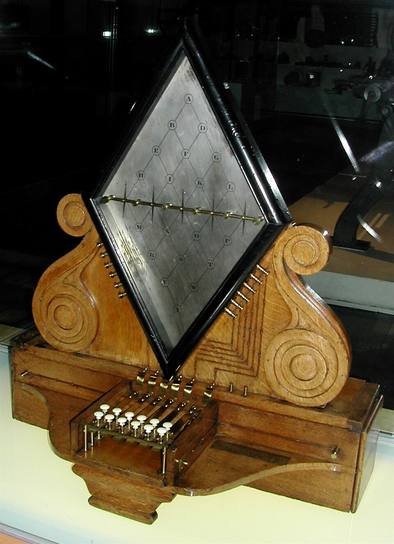
In Britain, William Fothergill Cooke and Charles Wheatstone patented a five-needle telegraph in 1837. Pairs of magnetic needles swung to point at letters on a diamond-shaped board, so operators needed no code at all. But the design needed six wires and could only show 20 letters (C, J, Q, U, X and Z were missing). It still went into service on the Great Western Railway in 1838, the first commercial electric telegraph, and later versions cut the number of needles and wires to two and then one.
A painter's idea at sea (1832)
Samuel F. B. Morse was not an engineer. He was a well-known American portrait painter. In the autumn of 1832, sailing home from Europe on the packet ship Sully, he heard a fellow passenger, the Boston scientist Charles T. Jackson, describe experiments with electromagnets. Morse reasoned that if current could be switched on and off at one end of a wire and detected at the other, those breaks could carry a message. He filled a sketchbook with ideas before the ship docked.
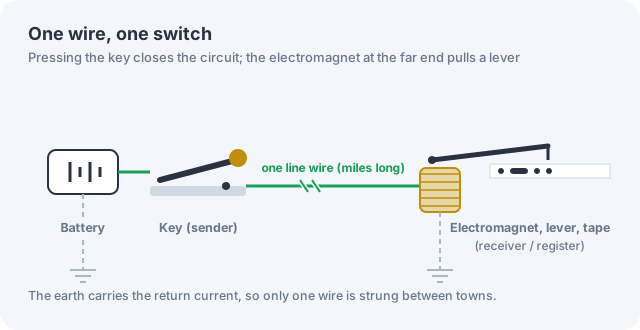
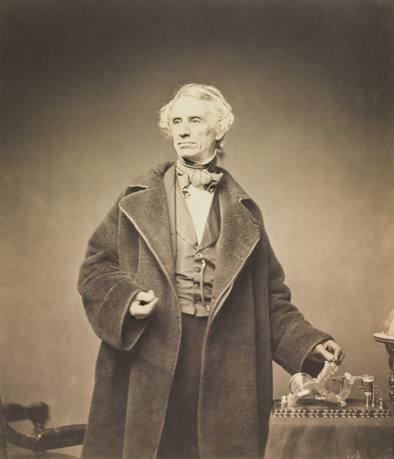
The key difference from Cooke and Wheatstone's design was simplicity: a single line wire and a switch. Everything else depended on the code.
Enter Alfred Vail (1837)
Progress was slow until September 1837, when Alfred Vail saw a demonstration at New York University. Vail was a skilled mechanic whose family owned the Speedwell Ironworks in Morristown, New Jersey. With his father Stephen's money, he agreed to build the equipment in return for a share of the rights.
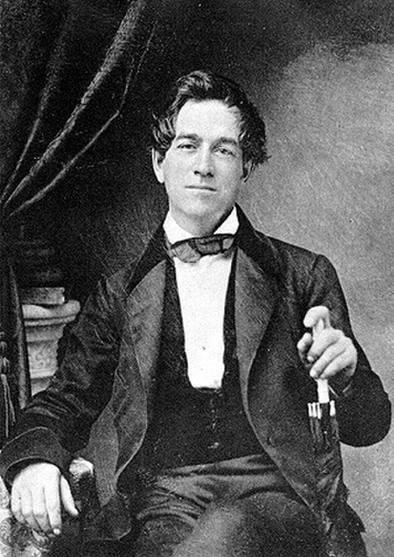
Vail turned Morse's rough prototype into working machines. He designed the sending key, a sprung lever that closes the circuit when pressed, and improved the register, a clockwork device that pulled a strip of paper under a stylus. When current flowed, an electromagnet pressed the stylus into the paper, embossing a short or long mark.
From a number code to an alphabet
Morse's first code, in 1837, did not spell words at all. It sent numbers, and each number stood for a word in a printed codebook. By early 1838 this had been replaced by an alphabet of dots and dashes that could spell anything. Who designed it is still debated: some historians credit Vail, while Vail himself attributed the code to Morse in his 1845 book on the telegraph.
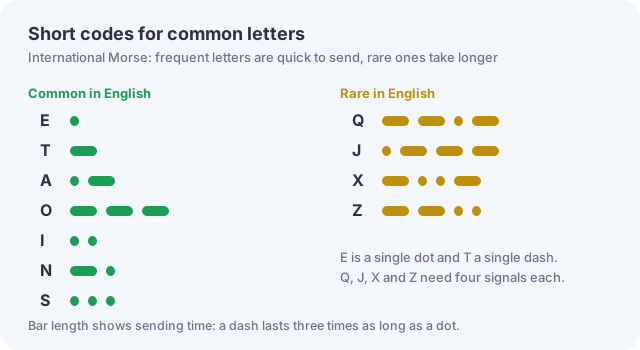
The code's cleverest feature is that common letters are quick to send. According to the traditional story, Vail visited a newspaper office in Morristown and counted the pieces of type in the printer's cases: printers kept the most type for the letters they used most. Whether or not it happened exactly that way, the result was the same. E, the most common letter in English, became a single dot, and T a single dash. You can run the same kind of count on any text with our Frequency Analyzer.
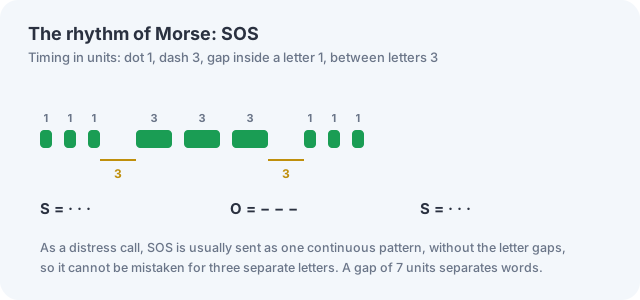
It doesn't stand for anything. SOS was chosen in 1906 because its pattern, three dots, three dashes, three dots, is easy to send and impossible to mistake. It is sent as one continuous signal, not as three letters. "Save Our Souls" and "Save Our Ship" are later inventions that fit the letters.
"What hath God wrought" (1844)
Morse spent years trying to win funding. In 1843 Congress finally voted $30,000 to build an experimental line between Washington and Baltimore, about 40 miles. Wires were first laid in underground pipes, which failed, and were then strung on wooden poles along the railway.
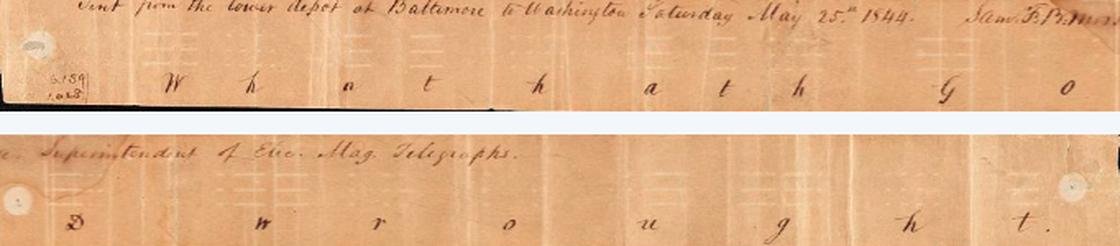
On 24 May 1844, sitting in the Supreme Court chamber of the U.S. Capitol, Morse sent the first official message to Vail in Baltimore: "What hath God wrought," a line from the Bible (Numbers 23:23) suggested by Annie Ellsworth, the young daughter of a friend. Vail sent it straight back. Days later the line carried news from the Democratic convention in Baltimore to Washington faster than any train.
From paper tape to listening
The register was meant to leave a written record, and operators read the marks off the tape. But they soon noticed something: each mark came with a click from the moving lever, and an experienced operator could understand the message by ear, faster than reading the tape. Telegraph offices adopted the sounder, a simple device designed to make clear clicks, and receiving by ear became the normal way to work. The rhythm of the code, not its marks on paper, became what operators learned.
American Morse and the international version
The code used in the United States, now called American Morse, had quirks. Some letters contained gaps: C was two dots, a space and a dot. The letter L was a long dash, and zero an even longer one. Experienced operators coped, but the extra lengths and gaps made errors easy.
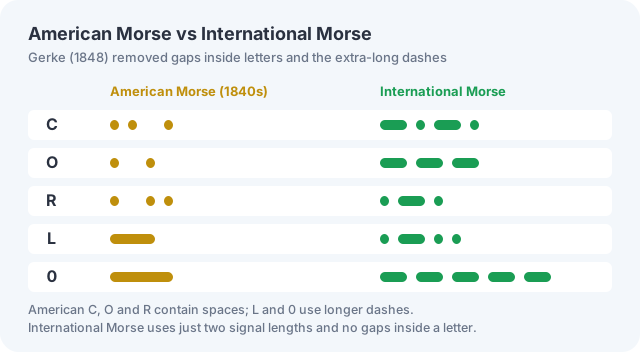
In 1848 Friedrich Clemens Gerke, an inspector on the new Hamburg–Cuxhaven telegraph line in Germany, rewrote nearly half the code. His version used only two signal lengths, a dot and a dash three times as long, and no gaps inside letters. In 1851 the German-Austrian Telegraph Union adopted it, and in 1865 the International Telegraph Union, founded that year at a conference in Paris, made a slightly modified version the international standard. This is International Morse Code, the version our Morse Code Converter uses. American Morse stayed on North American landlines for about another century.
| Year | Event |
|---|---|
| 1794 | Chappe's optical telegraph links Paris and Lille |
| 1832 | Samuel Morse sketches an electric telegraph aboard the Sully |
| 1837 | Cooke and Wheatstone patent the needle telegraph; Alfred Vail joins Morse |
| 1838 | A dot-and-dash alphabet replaces Morse's number code |
| 1843 | Congress funds the Washington–Baltimore line |
| 1844 | "What hath God wrought" is sent on 24 May |
| 1848 | Gerke simplifies the code for German lines |
| 1865 | International Morse Code adopted in Paris |
| 1906–1908 | SOS agreed in Berlin, in force from 1 July 1908 |
| 1999 | Ships switch from Morse to the satellite-based GMDSS |
| 2007 | US amateur radio licences no longer require a Morse test |
The first instant network
Within a few years, telegraph wires ran beside railways across the United States and Europe. News agencies, stock exchanges, railways and governments came to depend on them. A permanent transatlantic cable followed in 1866, and a message that once took around ten days by ship could cross the ocean in minutes. Later, teleprinters let operators type messages instead of tapping them, a story told in our history of the keyboard.
Wireless and SOS
In the late 1890s Guglielmo Marconi showed that signals could travel by radio, without wires. Morse code was ideal for early radio, which could only switch a signal on and off, and ships began carrying radio operators.
Distress signals at first varied by company: Marconi's operators used CQD. At the first International Radiotelegraph Convention, in Berlin in 1906, countries agreed on SOS (· · · − − − · · ·), which came into force on 1 July 1908. When the Titanic sank in April 1912, its operators sent both CQD and SOS.
Morse code today
Ships kept Morse for distress calls until 1999, when the Global Maritime Distress and Safety System (GMDSS), based on satellites and digital radio, fully replaced it. The United States stopped requiring a Morse test for amateur radio licences in 2007.
Yet Morse has not disappeared. Many amateur radio operators still use it by choice, because a simple on-off signal gets through noise and weak conditions where voice fails. Aircraft radio beacons such as VORs and NDBs still identify themselves with a short Morse callsign, so pilots can check they are tuned to the right station. Morse is also used in assistive technology, where a person who can make only two kinds of movement, such as a short and a long switch press, can type full text. If you need to spell out letters by voice rather than signal, the NATO phonetic alphabet does that job.
Send your own message in Morse
Type any text into our free Morse Code Converter to turn it into dots and dashes, or paste Morse to decode it back to text. It uses International Morse Code and runs entirely in your browser.
Open the Morse Code Converter →Frequently asked questions
Who invented Morse code?
Samuel Morse and Alfred Vail developed it between 1837 and 1838. Morse conceived the single-wire telegraph and a first number code; who designed the dot-and-dash alphabet is debated, and Vail himself credited Morse. Friedrich Gerke later simplified it into the basis of International Morse Code.
What was the first Morse code message?
"What hath God wrought," sent by Samuel Morse from the U.S. Capitol in Washington to Alfred Vail in Baltimore on 24 May 1844. The words, from the Bible, were suggested by Annie Ellsworth.
Why is E a single dot in Morse code?
Because E is the most common letter in English. The code gives the shortest signals to the most frequent letters so messages can be sent faster.
Is Morse code still used?
Yes, though no longer for ship distress calls. Amateur radio operators use it widely, aviation beacons identify themselves in Morse, and it helps some people with disabilities communicate.
Sources
- Invention of the Telegraph, Library of Congress
- Ocean Liner Talk Spurs Telegraph Invention, Ocean Liners Magazine
- Morse Transmits the First Message by Morse Code, HistoryofInformation.com
- Cooke and Wheatstone five-needle telegraph, Science Museum Group
- Friedrich Clemens Gerke, Wikipedia
- SOS, Wikipedia