From Able Baker to Alfa Bravo: The History of the NATO Phonetic Alphabet
"B" or "D"? "M" or "N"? Over a crackling radio, single letters are easy to mishear. The fix was to give every letter a word, and it took the world about thirty years to agree on which words.
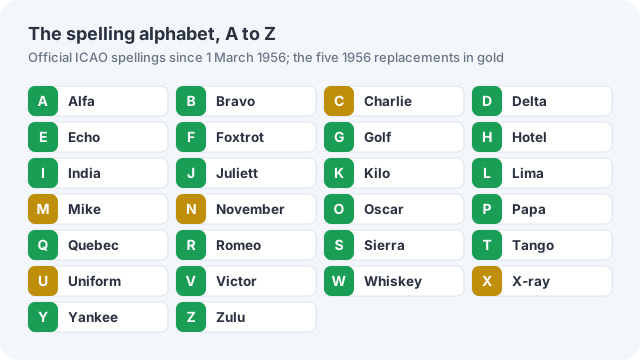
Pilots, soldiers, sailors, call-centre staff and anyone reading out a booking reference use the same 26 words today: Alfa, Bravo, Charlie and so on. The list was not invented by NATO, and it was not the first attempt. Here is how it was built, tested, changed and finally adopted in 1956, and why two of its words are spelled "wrong" on purpose.
Why letters need words
Spoken letter names are short and many sound almost the same. In English, B, C, D, E, G, P, T and V all end in the same "ee" sound; M and N differ by a single consonant; F, S and X all start with "e". On a clear line that is fine. Through static, a weak signal or a noisy cockpit, it causes errors, and in aviation or warfare an error can be fatal.
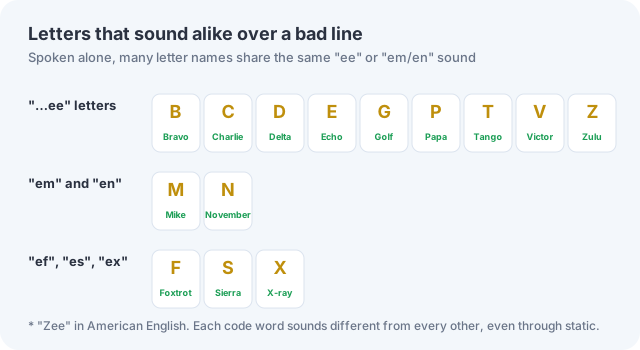
A spelling alphabet solves this by replacing each letter with a whole word that starts with it. A word has more sounds than a letter, so even if part of it is lost, the listener can still recognize it. Linguists often call these "phonetic" alphabets, although strictly they are spelling alphabets: they spell words out rather than describe sounds.
Early alphabets: cities, apples and "ack-ack"
As telephone and radio spread in the early 20th century, many organizations made their own lists. During the First World War, British army signallers used words such as Ack for A, Beer for B and Pip for P. Some survived in slang: anti-aircraft fire became "ack-ack," and the afternoon became "pip emma" (p.m.). The Royal Navy had its own list starting Apples, Butter, Charlie.
The first internationally recognized spelling alphabet came from the International Telecommunication Union (ITU) in 1927, and was revised in 1932. It relied mostly on place names: Amsterdam, Baltimore, Casablanca, Denmark, Edison and so on. Place names worked well for many Europeans but poorly for others, and armed forces kept using their own lists.
Able Baker: the Second World War alphabet
In November 1940 the United States' Joint Army/Navy board agreed a single alphabet for all American forces. It took effect on 1 March 1941 and was known as "Able Baker" after its first two words: Able, Baker, Charlie, Dog, Easy, Fox, George and so on.
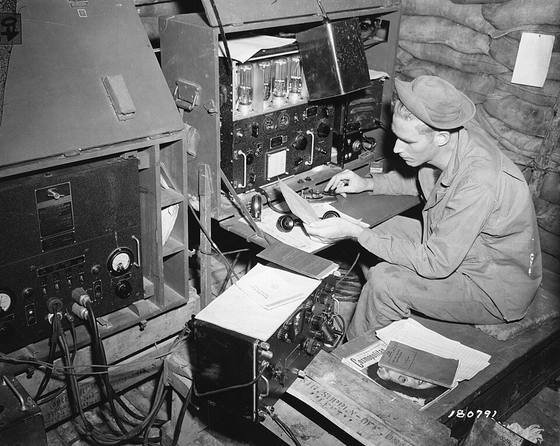
British services had their own lists, which was a problem once American and British crews were flying and fighting side by side. In 1942–43 the Royal Air Force switched to Able Baker so Allied aircrews used the same words. Some of those words outlived the alphabet: R was "Roger," which is why pilots still say "Roger" to mean "message received."
Not quite. The alphabet was developed for civil aviation under the International Civil Aviation Organization (ICAO), and its official name is the International Radiotelephony Spelling Alphabet. It is called the "NATO alphabet" because NATO members led its final revision and adopted it in 1956. Pilots and air traffic controllers often call it the ICAO alphabet instead.
A truly international alphabet (1948–1951)
After the war, international air travel grew quickly, and pilots and controllers from many countries had to understand each other by radio. Able Baker was built for English speakers. Words like Dog, Easy or Sugar could be hard for others to recognize or pronounce.
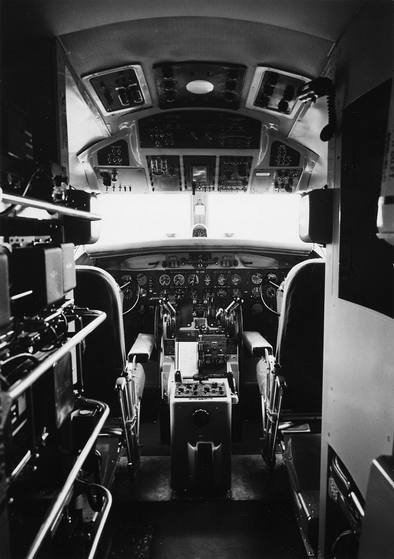
ICAO set out to design something better. In 1948 and 1949, Jean-Paul Vinay, a professor of linguistics at the Université de Montréal, worked with ICAO's language section on the rules. Each word had to:
- start with the letter it represents;
- exist in, or be easy to say in, English, French and Spanish, and be spelled similarly in all three;
- sound clearly different from every other word on the list, even over a poor radio link;
- carry no offensive or awkward meaning.
The result took effect for civil aviation on 1 November 1951. It already included many familiar words, such as Alfa, Bravo, Delta, Echo and Foxtrot, but five were different: Coca for C, Metro for M, Nectar for N, Union for U and Extra for X.
Testing, complaints and five new words (1952–1956)
Not everyone was happy. Pilots and military users reported words that were easy to confuse in practice: Nectar, for example, could be mistaken for Victor. Between 1952 and 1955, ICAO tested the alphabet with speakers from 31 countries, with much of the work funded by Canada, the United Kingdom and the United States.
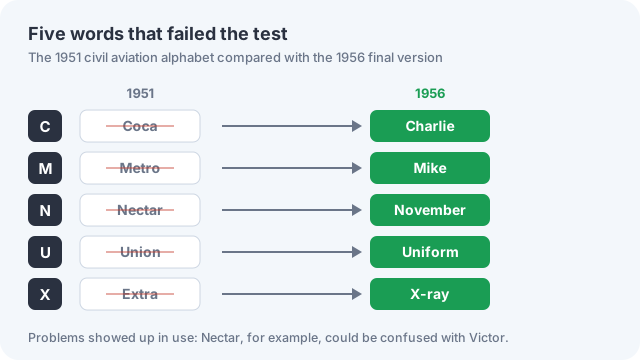
NATO, which needed a common alphabet for its forces, joined the review in the mid-1950s with the UK and US leading. The proposal kept most of the 1951 list but replaced the five problem words with Charlie, Mike, November, Uniform and X-ray. N was the last to be settled, with some still arguing for Nectar. NATO first planned to switch on 1 January 1956, but most allies waited for ICAO's decision. The final version came into force for both civil aviation and NATO on 1 March 1956.
Others followed: the ITU adopted it for radio services in 1959, and it became the standard for shipping in 1965. The 26 words have not changed since.
Why "Alfa" and "Juliett"?
Two official spellings look like typos to English speakers, but they are deliberate.
- Alfa instead of "Alpha": in languages such as Spanish or Italian, a reader might not know that "ph" is pronounced like "f." Writing it with an f removes the doubt.
- Juliett instead of "Juliet": in French, a single "t" at the end of a word is often silent. The double t tells a French speaker to pronounce it.
Many people still write Alpha and Juliet, and our NATO Phonetic Alphabet converter uses those familiar spellings. In aviation radio, the official forms are standard.
| Letter | Word | Letter | Word |
|---|---|---|---|
| A | Alfa | N | November |
| B | Bravo | O | Oscar |
| C | Charlie | P | Papa |
| D | Delta | Q | Quebec |
| E | Echo | R | Romeo |
| F | Foxtrot | S | Sierra |
| G | Golf | T | Tango |
| H | Hotel | U | Uniform |
| I | India | V | Victor |
| J | Juliett | W | Whiskey |
| K | Kilo | X | X-ray |
| L | Lima | Y | Yankee |
| M | Mike | Z | Zulu |
Numbers get special treatment too
Digits can be misheard as well, so aviation radio uses adjusted pronunciations. Three is said "tree," because the "th" sound is hard for many speakers. Four is "fow-er," so it is not heard as "for." Five is "fife," which cannot be confused with "fire." Nine is "niner," so it does not sound like the German nein ("no"). These forms are written into ICAO and national aviation rules.
Who uses it today
The alphabet is used every day in aviation, by militaries, at sea, by police and emergency services, and by amateur radio operators. Outside those fields, it helps anyone who has to spell a name, a postcode or a booking code over the phone. Its words have also leaked into everyday language: military slang such as Oscar Mike ("on the move"), and Zulu time for Coordinated Universal Time.
It shares a goal with an older system: getting letters through a noisy channel without mistakes. Read the history of Morse code for the 19th-century version of the same problem.
Spell it out, Alfa to Zulu
Type a name, booking reference or call sign into our free NATO Phonetic Alphabet converter to see it spelled with code words, or turn code words back into text.
Open the NATO Phonetic Alphabet tool →Frequently asked questions
Who created the NATO phonetic alphabet?
It was developed for civil aviation under ICAO, with linguist Jean-Paul Vinay of the Université de Montréal setting the selection rules in 1948–49. A first version took effect in 1951; NATO members led the 1956 revision, which is why it is called the NATO alphabet.
When was the current alphabet adopted?
The final version, with Charlie, Mike, November, Uniform and X-ray, came into force for civil aviation and NATO on 1 March 1956. The ITU adopted it in 1959.
Why is it spelled Alfa and Juliett?
So that non-English speakers pronounce them correctly. "Ph" may not be read as "f" in some languages, and French speakers may not pronounce a single final "t".
What was used before Alfa Bravo?
In the Second World War, American and later British forces used the "Able Baker" alphabet (Able, Baker, Charlie, Dog, Easy…). Earlier international lists from the ITU used place names such as Amsterdam and Baltimore.
Sources
- NATO phonetic alphabet, NATO
- As easy as Alfa Bravo Charlie, ICAO Uniting Aviation
- Allied military phonetic spelling alphabets, Wikipedia
- Alfa, Bravo, Charlie: Why the NATO Phonetic Alphabet Is Misspelled on Purpose, AeroCorner