Merry Christmas in 160 Characters: The History of Texting
The first text message was two words long and sent from a computer, because no phone could type one yet. Within a decade, hundreds of millions of people were tapping out messages with their thumbs.
Text messaging was never meant to be a big deal. It started as a side feature squeezed into spare capacity on mobile networks, with a limit chosen by looking at postcards. Here is how SMS got its famous 160-character limit, why typing on a number pad was so painful, how T9 fixed it, and how a small technical constraint shaped the way we write.
An idea for the new GSM phones (1984–1985)
In the early 1980s, European countries were planning a shared digital mobile phone standard that became GSM. In 1984, as part of a Franco-German working group, the German engineer Friedhelm Hillebrand and his French colleague Bernard Ghillebaert developed the idea of sending short text messages to and from mobile phones. They presented it to the GSM standards group in February 1985.
The name was deliberately modest: Short Message Service, or SMS. At first it was widely seen as a minor extra, useful for things like voicemail alerts, rather than a new way for people to talk.
Why 160 characters?
Hillebrand had to decide how long a message could be. He looked at the kinds of short written messages people already sent, such as postcards and telex messages, and concluded that 160 characters was enough for most everyday communication. A short message did not need to be long; it needed to fit the space the network could spare.
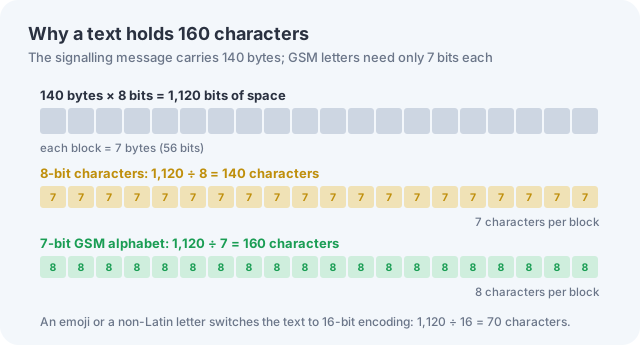
That space was tight. Mobile networks constantly exchange signalling messages, the behind-the-scenes traffic that sets up calls and tracks where phones are. SMS was designed to travel inside these signalling messages, using spare capacity when no calls were being set up, so it cost almost nothing to carry. The catch was size. The signalling message that carries a text has room for just 140 bytes, or 1,120 bits, of content. Early plans allowed only 128 bytes; the final standard settled on 140.
Ordinary computer text uses 8 bits per character, which would allow 140 characters. GSM engineers created a 7-bit alphabet (the GSM 03.38 character set) with the letters, numbers and symbols most European languages need. At 7 bits each, 1,120 bits hold exactly 160 characters.
The same arithmetic still applies. If a message contains an emoji, or letters outside the GSM alphabet such as Greek, Arabic or Chinese, the phone switches to a 16-bit encoding and the limit drops to 70 characters. Longer texts are split into several parts and joined back together by the receiving phone. Want to see how close you are to the limit? Paste your message into our Word & Character Counter.
"Merry Christmas" (3 December 1992)
The first text message was sent on 3 December 1992 on the Vodafone network in the United Kingdom. Neil Papworth, a 22-year-old engineer at Sema Group, typed "Merry Christmas" on a computer and sent it to Richard Jarvis, a Vodafone director who was at the company's Christmas party. Jarvis received it on an Orbitel 901, a heavy early GSM handset. He could not reply: phones of the time could receive texts but not write them.
That changed quickly. In 1993 the Finnish operator Radiolinja launched the first commercial person-to-person text service, and Nokia phones of the period let users write messages on the keypad. The real question was how anyone would type comfortably on twelve keys.
Twelve keys and a lot of tapping
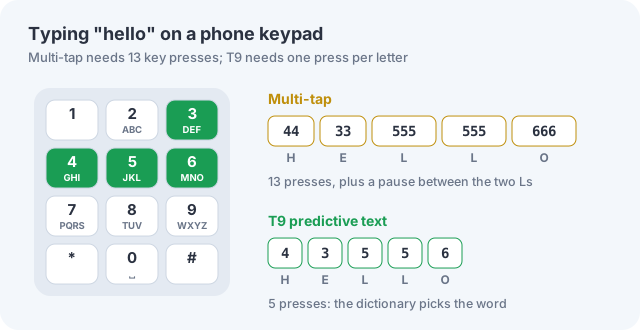
Mobile phones had a standard telephone keypad: the digits 0 to 9, plus * and #. Letters were printed on the number keys, three or four per key, following the layout used on push-button phones. To type with multi-tap, you pressed a key repeatedly to cycle through its letters: once for A, twice for B, three times for C. The letter S took four presses of the 7 key.
Typing "hello" took 13 presses, and two letters on the same key, like the double L, meant waiting for the cursor to move on before pressing again. Multi-tap was slow, needed constant attention to the screen, and made mistakes easy. Yet people put up with it, which says a lot about how much they wanted to text.
T9: one press per letter
The fix came from an unexpected direction. Martin King had been building an eye-tracking communication device for people with severe disabilities, who could choose between only a few positions with their eyes. With Cliff Kushler, he studied how to enter text with very few inputs, and realized a dictionary could do much of the work. In 1995 they founded Tegic Communications in Seattle to develop the idea; Dale Grover is also named on the early patents.
Their system, T9 ("Text on 9 keys"), let you press each key just once per letter. For "hello" you pressed 4-3-5-5-6, and the software compared the sequence with its dictionary to find the most likely word. You can try it on any phrase with our T9 Converter.
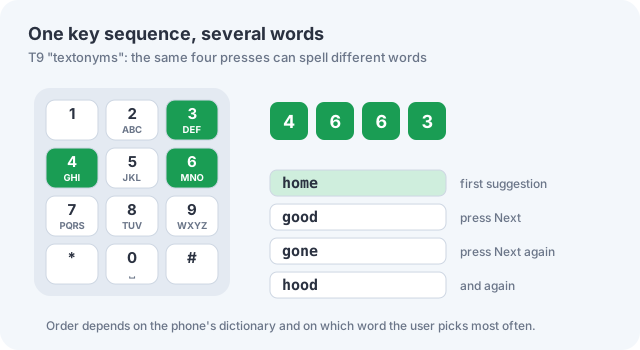
Sometimes several words share a sequence. Pressing 4-6-6-3 could mean home, good, gone or hood, and 2-6-6-5 could be book, cook or cool. Users pressed a "Next" key to cycle through the options. These clashes became known as textonyms.
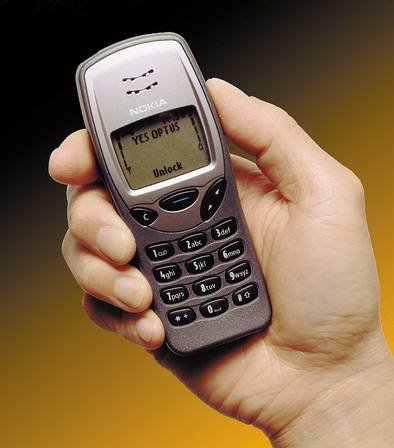
In April 1999 Nokia announced it was adding T9 to its GSM phones, starting with the Nokia 7110 and 3210; the hugely popular 3310 followed in 2000. Other manufacturers licensed it too, and T9 ended up on hundreds of millions of phones. AOL bought Tegic in 1999 for about $350 million, and Nuance Communications bought it in 2007. Kushler went on to co-found Swype, which let people type on touchscreens by sliding a finger from letter to letter.
Not quite. Abbreviations like LOL and BRB come from 1980s online chat rooms and bulletin boards; LOL appears in a list of online acronyms in 1989, three years before the first text. SMS did not invent textspeak, but the 160-character limit, fiddly keypads and per-message charges made it part of everyday life.
Txt spk and the price of a message
By the early 2000s texting was a mass habit, especially among teenagers. Operators usually charged for each message sent, and one text meant at most 160 characters, so every letter counted. Writers dropped vowels, used numbers for sounds and swapped words for letters: c u l8r, gr8, thx, u for "you". Some people worried that textspeak would ruin spelling; others pointed out that you have to know how a word is spelled to shorten it on purpose.
The habit also changed capitals. Many texters skipped the Shift key entirely or typed in all capitals for emphasis. If you need to tidy up a message written that way, our Case Converter can fix it in one click, and the story of the two letter cases is told in Uppercase and Lowercase.
The 140-character legacy
When Twitter launched in 2006, posts could be sent and received by text message. Its founders set a limit of 140 characters, leaving 20 of an SMS's 160 for the sender's username. The limit became the platform's signature long after most people stopped using it by SMS. Twitter doubled it to 280 characters in November 2017.
| Year | Event |
|---|---|
| 1984 | Hillebrand and Ghillebaert develop the SMS concept for GSM |
| 1985 | SMS proposal presented to the GSM standards group |
| 1992 | Neil Papworth sends "Merry Christmas" on 3 December |
| 1993 | First commercial person-to-person text service (Radiolinja, Finland) |
| 1995 | Martin King and Cliff Kushler found Tegic, the company behind T9 |
| 1999 | Nokia adds T9 to the 7110 and 3210; AOL buys Tegic |
| 2006 | Twitter launches with a 140-character limit built around SMS |
| 2007 | Nuance buys Tegic |
| 2017 | Twitter raises its limit to 280 characters |
Texting today
Touchscreen keyboards with autocorrect replaced keypads, and internet messaging apps replaced many SMS conversations, with no character limit and no per-message charge. But SMS has not gone away. It still works on almost any mobile phone, needs no app and no data connection, and is widely used for delivery updates, appointment reminders and one-time login codes.
The keypad lives on too, in escape rooms, puzzle hunts and nostalgia. For the longer story of how we went from typewriters to touchscreens, read the history of the keyboard, and for the 19th-century ancestor of the text message, see the history of Morse code.
Type like it's 1999
Turn any message into T9 key presses, or decode a string of numbers back into words, with our free T9 Converter. It runs entirely in your browser.
Open the T9 Converter →Frequently asked questions
Why are text messages limited to 160 characters?
SMS travels inside mobile network signalling messages that carry 140 bytes (1,120 bits). Using a 7-bit alphabet, 1,120 bits hold 160 characters. Friedhelm Hillebrand judged that 160 characters was enough for most short messages, based on postcards and telex messages.
What was the first text message?
"Merry Christmas," sent by engineer Neil Papworth from a computer to Vodafone's Richard Jarvis on 3 December 1992 in the UK. Jarvis received it on an Orbitel 901 phone.
What does T9 stand for?
"Text on 9 keys." It was predictive text software from Tegic Communications that let users press each key once per letter while a dictionary worked out the word.
Why does my text message split when I add an emoji?
Emoji are not in the 7-bit GSM alphabet, so the phone switches to 16-bit encoding, which fits only 70 characters in one message. Longer texts are sent in parts and joined on arrival.
Sources
- SMS, Wikipedia
- How T9 Predictive Text Input Changed Mobile Phones, Gizmodo
- Nokia employs Tegic text input technology (April 1999), Wireless Design Online
- Tegic Communications, Wikipedia
- LOL, Wikipedia