Johannes Gutenberg: The Life of the Man Who Brought Printing to Europe
We cannot speak of typing without speaking of printing. And we cannot speak of printing without mentioning Gutenberg.
Every keyboard descends from a machine designed to imitate a printed page, and every printed page in the Western world goes back to a workshop in Mainz in the 1450s. The man behind it was an inventor, a businessman, a debtor and an exile. He changed the world and lost almost everything in the process. This is his story.
Early life in Mainz (c. 1400)
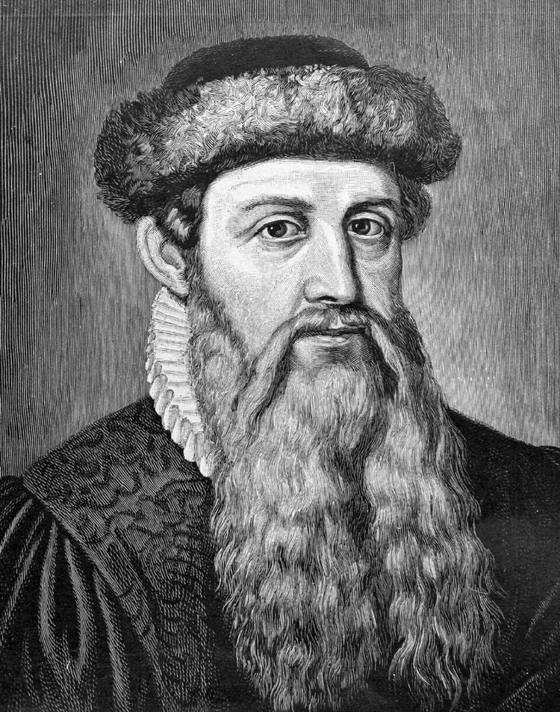
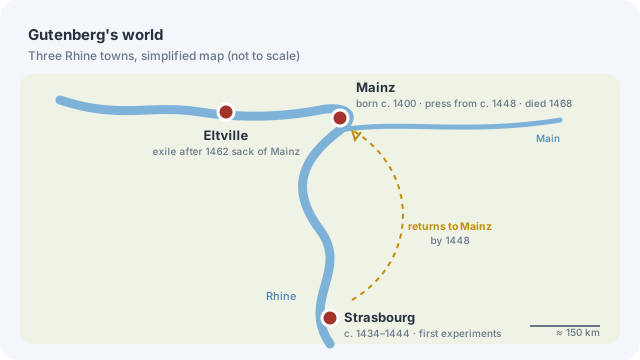
He was born Johannes Gensfleisch zur Laden zum Gutenberg in Mainz, a prosperous city on the Rhine in what is now Germany. Nobody recorded the date. Historians place it between 1393 and 1406, and 1400 is used by convention. The name "Gutenberg" came from the family house, the Hof zum Gutenberg.
His father, Friele Gensfleisch zur Laden, was a wealthy patrician merchant connected to the archbishop's mint, where coins were struck. His mother, Else Wyrich, came from a shopkeeper's family. Many biographers believe that because his mother was a commoner, Johannes could never inherit his father's position at the mint; others point out that, as the youngest son, he was unlikely to in any case. Either way, the mint may matter: it is where a young man could watch metal being cut, stamped and cast with precision.
Mainz was politically unstable. In the early 1400s the craft guilds rose against the patrician families more than once, and the Gutenbergs left the city for nearby Eltville at least twice.
Strasbourg and the secret project (c. 1434–1444)
By March 1434, Gutenberg was living in Strasbourg, then a German-speaking free city, today in France. Records suggest he worked as a goldsmith and was teaching gem polishing by 1437, skills that meant precise work with metals, moulds and alloys.
Around 1439 he started a business making polished metal mirrors for pilgrims traveling to see holy relics in Aachen. Pilgrims believed the mirrors could capture the relics' holy light. Then a severe flood postponed the pilgrimage by a year, and the partners' money was tied up. To keep them on board, Gutenberg offered a share in a different, secret project. Court papers from a lawsuit filed by his partners' heirs mention a press, metal "forms" and purchases of lead, strong hints that he was already experimenting with printing.
The invention: a system, not a machine
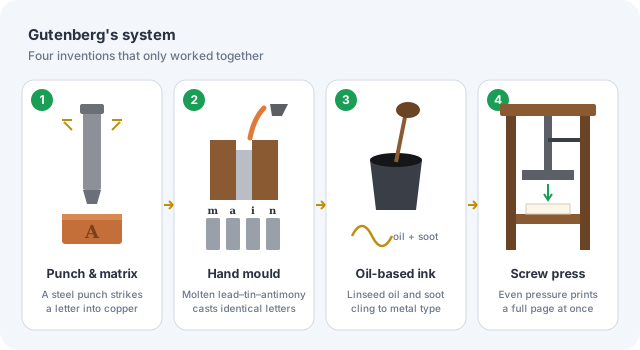
Gutenberg is often described as the inventor of "the printing press", but presses already existed for wine, olive oil and paper. His real achievement was combining four parts that only worked together:
- Punch and matrix. A letter was cut into the end of a hard steel punch, which was struck into softer copper to make a mould for that letter, called a matrix.
- The hand mould. The matrix fitted into an adjustable hand mould. Pouring in molten metal produced a piece of type, and it could be done again and again, fast, with every "a" identical to every other "a". The metal was an alloy of lead, tin and antimony that melted at a low temperature and cast sharp letters.
- Oil-based ink. The water-based inks used by scribes slid off metal. Gutenberg used a thick, varnish-like ink based on linseed oil and soot that stuck to type and transferred cleanly to paper.
- The screw press. A wooden press, adapted from the presses used for wine and paper making, pressed a whole page evenly in one pull.
Movable type itself wasn't new. It had been used in China since the 11th century and in Korea with metal type by the 14th. What Gutenberg built was a way to mass-produce type quickly and cheaply, which suited an alphabet of only a few dozen letters. For the wider story of how print fits between manuscripts and screens, see From Stone to Screen: A 5,000-Year History of Writing.
Back in Mainz: the workshop (c. 1448–1455)
By 1448, Gutenberg was back in Mainz and borrowing money. Printing was expensive to start: type had to be cast in the tens of thousands, and paper, vellum and ink all had to be paid for in advance.
Around 1450 he borrowed 800 guilders from Johann Fust, a wealthy Mainz merchant, and a second 800 guilders around 1452 for a much bigger project. Fust became his partner. While the big project took shape, the workshop paid its way with smaller jobs: Latin grammar books for schools and thousands of printed indulgences for the Church.
The Gutenberg Bible (c. 1455)
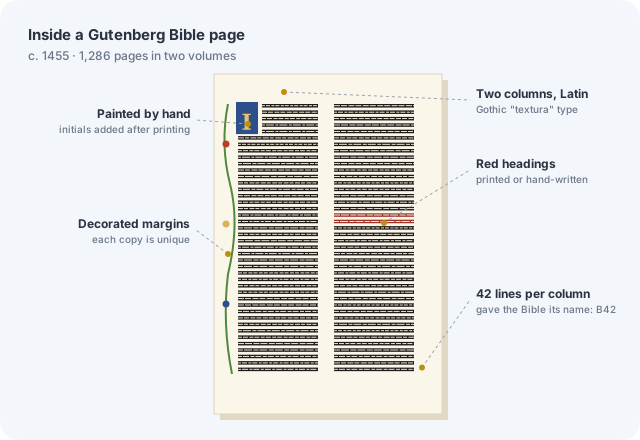
The big project was a Latin Bible, completed around 1455. It runs to 1,286 pages in two volumes, printed in two columns of Gothic type. Most pages have 42 lines per column, which is why it is also called the 42-line Bible, or B42.
About 180 copies were printed, roughly three-quarters on paper and the rest on vellum (fine calfskin). The printed pages were only the start: each buyer had their copy decorated by hand with painted initials, red headings and borders, so no two copies look alike. Today 48 substantially complete copies survive, and they rank among the most valuable books in the world.
The lawsuit that cost him his workshop (1455)
Just as the Bible was being finished, Fust sued. With interest at 6%, the loans had grown to about 2,026 guilders, and Fust also accused Gutenberg of using the money for other work. The archbishop's court ruled in Fust's favor and gave him control of the Bible workshop and its equipment.
Fust went into business with Peter Schöffer, Gutenberg's skilled assistant, who later married Fust's daughter. In 1457 their firm printed the Mainz Psalter, the first printed book to name its printers and give a date, and a showpiece with initials printed in red and blue. Gutenberg's name appears on none of the books now credited to him.
Later years, recognition and death (1456–1468)
Gutenberg seems to have kept printing on a smaller scale, and he may have been involved with the Catholicon, a large Latin dictionary printed in Mainz in 1460. In 1462, during a war between two rival archbishops, Mainz was sacked, and Gutenberg again moved to Eltville.
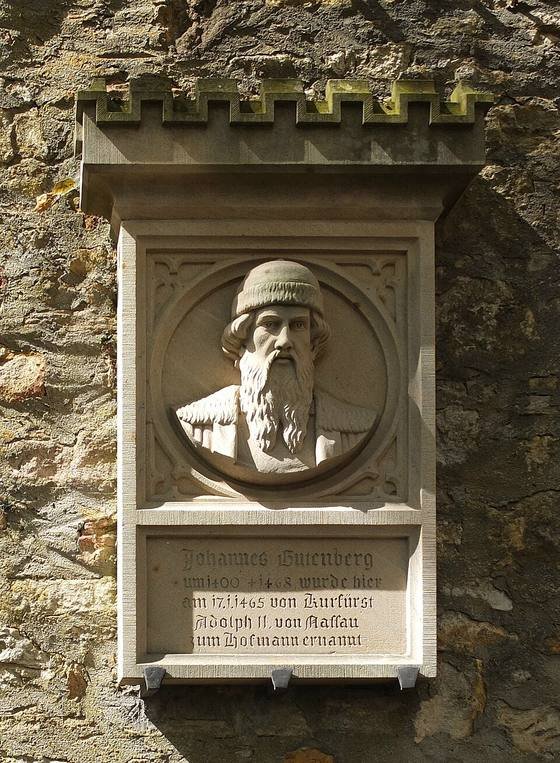
Recognition finally came in January 1465. Archbishop Adolf II of Nassau named him a Hofmann, a gentleman of the court, with a yearly allowance of clothing, grain and wine, free of tax.
He died in Mainz in early February 1468, probably in his late sixties. He was buried in the Franciscan church, which was later destroyed; his grave is lost.
Gutenberg's life at a glance
| Year | Event |
|---|---|
| c. 1400 | Born in Mainz (estimates range from 1393 to 1406) |
| 1434 | First recorded in Strasbourg |
| c. 1439 | Pilgrim-mirror venture; secret printing experiments |
| c. 1448 | Back in Mainz, borrowing to set up a workshop |
| c. 1450–52 | Two loans of 800 guilders each from Johann Fust |
| c. 1455 | The 42-line Bible is completed |
| 1455 | Fust wins his lawsuit and takes over the workshop |
| 1457 | Fust and Schöffer print the Mainz Psalter |
| 1462 | Mainz is sacked; Gutenberg moves to Eltville |
| 1465 | Named a gentleman of the archbishop's court |
| 1468 | Dies in Mainz in February |
Why Gutenberg still matters
Within 50 years of his Bible, print shops were running in more than 200 European cities, and millions of books had been printed. Books became cheaper, ideas traveled faster, and texts stayed identical from copy to copy. Historians link that flood of print to the spread of Renaissance learning, the Protestant Reformation and the Scientific Revolution. In 1997, Time-Life chose Gutenberg's invention as the most important of the second millennium.
His influence is also on your screen right now. Typography still uses printers' words: font, leading (from the strips of lead between lines), and uppercase and lowercase, after the cases where printers kept capital and small letters. The typewriter was built to put a small print shop on every desk, and its keyboard became ours. We follow that thread in From Typebars to Touchscreens: The History of the Keyboard.
Gutenberg made the edges of his columns perfectly straight (justified) by using extra versions of letters and abbreviations of different widths, so every line came out the same length. Writers today still face the same puzzle on every platform with a length limit. Our Word & Character Counter handles that part without the molten metal.
From movable type to your browser
Switch text between uppercase and lowercase, two forms of the alphabet that printers kept in separate cases, with our free Case Converter.
Open the Case Converter →Frequently asked questions
What did Johannes Gutenberg invent?
He developed a complete system for printing with movable metal type: a hand mould to cast type quickly and identically, a suitable metal alloy, an oil-based ink, and an adapted screw press. Together they made mass printing practical in Europe around 1450.
Did Gutenberg invent movable type?
No. Movable type was used in China from the 11th century, and Korea printed with metal type by the 14th century. Gutenberg independently developed a system that made producing and printing with type fast and cheap enough for mass production.
How many Gutenberg Bibles are left?
About 180 copies were printed around 1455. Today 48 substantially complete copies survive, in libraries and collections around the world.
What did Gutenberg look like?
Nobody knows. No portrait made during his lifetime survives. The familiar bearded portraits were created after his death and are imaginary.