The Rosetta Stone: How a Broken Slab Unlocked Egyptian Hieroglyphs
For about 1,400 years, nobody in the world could read Egyptian hieroglyphs. A stone found in a crumbling fort in 1799 changed that.
It isn't beautiful, and it isn't even complete: just a dark, broken slab carrying a decree written by a committee of priests. But because that decree was carved in three scripts, it became the most famous code key in history. Here is what it says, how it was found, how two rival scholars raced to read it, and why it is still argued over.
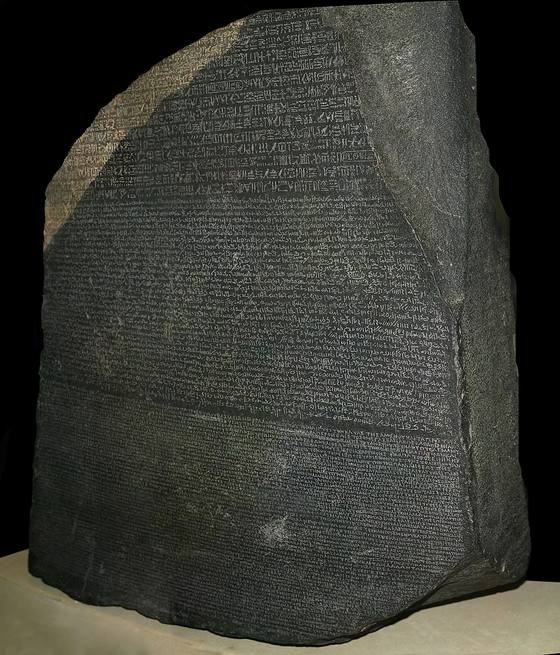
What the Rosetta Stone is
The Rosetta Stone is a fragment of a stele, an upright stone slab set up to display an official text. It is made of granodiorite, a dark igneous rock that early descriptions often called granite or basalt. The surviving piece measures 112.3 cm high, 75.7 cm wide and 28.4 cm thick (about 44 × 30 × 11 inches) and weighs roughly 760 kg (1,680 lb).
That is only part of the original. The stele was probably close to 150 cm tall with a rounded top, and most of the hieroglyphic section is gone: only its last 14 lines survive.
A decree from 196 BCE
The text is a decree passed by a council of Egyptian priests meeting at Memphis, dated to 27 March 196 BCE. Egypt was then ruled by the Ptolemies, a Greek-speaking Macedonian dynasty founded after Alexander the Great's conquest. The king, Ptolemy V Epiphanes, had come to the throne as a small child and was only about 13 when the decree was issued.
The priests praised the young king for his gifts of silver and grain to the temples, for cancelling some taxes and debts, and for controlling a dangerous Nile flood. In return, they set up a cult in his honor, with yearly festivals for his birthday and coronation. The decree ended with an instruction: copies were to be carved on stone stelae and set up in temples across Egypt, written in "sacred," "native" and "Greek" letters. That instruction is why the stone exists, and why it could be read.
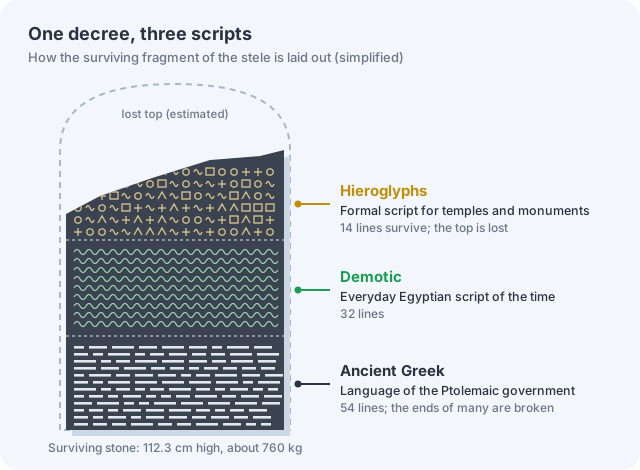
Three scripts, two languages
A common mistake is to say the stone is written in three languages. It is written in three scripts but only two languages: Egyptian (in two different scripts) and Greek.
| Section | Script | Language | Who used it | Lines surviving |
|---|---|---|---|---|
| Top | Hieroglyphs | Egyptian | Priests, for temple and monumental texts | 14 (damaged) |
| Middle | Demotic | Egyptian | Scribes, for everyday documents and business | 32 |
| Bottom | Greek alphabet | Ancient Greek | The royal court and government | 54 |
Hieroglyphs were already around 3,000 years old by 196 BCE. Demotic was a fast, joined-up script used for ordinary records. For how these scripts fit into the bigger story, from clay tablets to keyboards, see From Stone to Screen: A 5,000-Year History of Writing.
Found in a fort wall (1799)
In 1798 Napoleon Bonaparte invaded Egypt, bringing more than 150 scholars along with his army. In mid-July 1799 (sources give the 15th or the 19th), French soldiers were rebuilding an old fort near the town of Rashid, which Europeans called Rosetta, in the Nile Delta. While knocking down a wall of what the French called Fort Julien, they found a slab of dark stone covered in writing. Centuries earlier it had been reused as building material, most likely in the foundations of a fortress built by the Mamluk sultan Qaitbay in the late 1400s.
The officer in charge, engineer lieutenant Pierre-François Bouchard, saw at once that the inscription might matter: one of the three texts was Greek, which scholars could read. The stone was sent to the new Institute of Egypt in Cairo. There, experts inked the carved surface and pressed paper onto it, using the stone itself as a printing block, a trick Johannes Gutenberg would have recognized. Prints reached Paris, so the race to read it began before the French lost it.
From French find to British Museum (1801–1802)
The French campaign failed. In 1801, after British and Ottoman forces defeated the French army, the Capitulation of Alexandria required the French to hand over the antiquities they had collected. The stone traveled to England on HMS Égyptienne and landed at Portsmouth in February 1802.
The stone has been on display at the British Museum since June 1802, leaving the building only twice: in 1917, when it was moved to an underground postal railway station in London to protect it from wartime bombing, and for one month in 1972, when it was lent to the Louvre in Paris for the 150th anniversary of its decipherment.
The race to read it
The Greek was translated by 1803. That told scholars roughly what the Egyptian texts said, but not how to read the signs, and the versions are not word-for-word copies.
Demotic gave way first. In 1802 the French scholar Silvestre de Sacy and the Swedish diplomat Johan David Åkerblad picked out personal names in the Demotic text, such as Ptolemy, by finding groups of signs that appeared in the same places and as often as the names did in the Greek. It is the same idea behind modern word frequency analysis: count what repeats, and patterns start to show.
Hieroglyphs were harder. Back in 1761 the French scholar Jean-Jacques Barthélemy had suggested that cartouches, the oval rings around some groups of signs, held names. The English physician and physicist Thomas Young took this further. Starting in 1814 he showed that the cartouche on the Rosetta Stone spelled the name Ptolemy and worked out sound values for several of its signs. He published his results in an 1819 article in the Encyclopaedia Britannica. But Young believed sound-signs were used only to spell foreign names, and that native Egyptian words were written in symbols.
Champollion's breakthrough (1822)
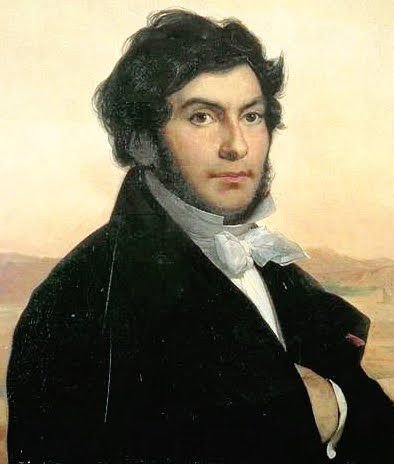
Jean-François Champollion (1790–1832) had been fascinated by Egypt since childhood. Crucially, he knew Coptic, the last stage of the Egyptian language, written in a Greek-based alphabet and still used in Coptic Church services. If hieroglyphs recorded Egyptian, Coptic could tell him what many of the words sounded like.
In 1822 he received a copy of the inscriptions on an obelisk from Philae, in southern Egypt, which had a Greek inscription naming Cleopatra on its base. He compared her cartouche with Ptolemy's. The signs for P, O and L appeared in both names, in the places where they belonged, which confirmed that the signs stood for sounds. He also noticed that the "t" in each name was written with a different sign, an early clue that some sounds could be written more than one way.
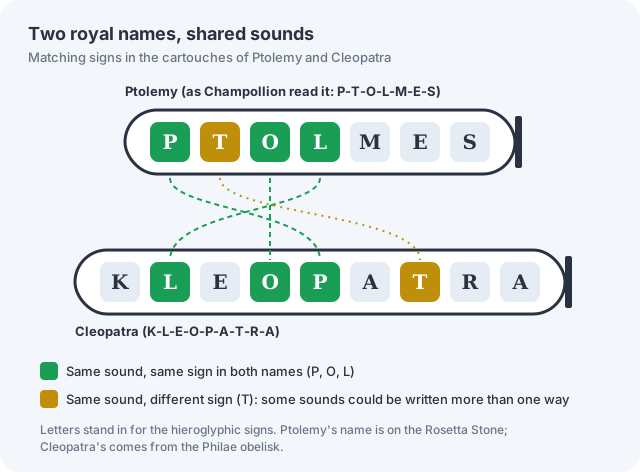
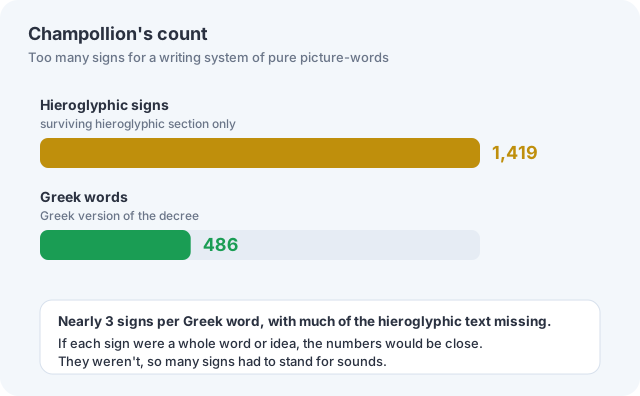
He then made a simple count that changed everything. The surviving hieroglyphic section has 1,419 signs, while the Greek text has only 486 words. If every hieroglyph stood for a whole word or idea, the numbers should have been close. They weren't, so many signs had to stand for sounds.
On 14 September 1822, after his readings worked on newly copied names of the pharaohs Ramesses and Thutmose, Champollion is said to have run to his brother's office shouting "Je tiens mon affaire!" ("I've got it!") before collapsing. On 27 September he presented his results to the French Academy in a famous paper, the Lettre à M. Dacier. In his 1824 book, the Précis du système hiéroglyphique, he showed that hieroglyphs mixed signs for sounds with signs for whole words and silent "determinatives" that mark a word's category. That mix is what had defeated everyone for centuries.
Young and Champollion argued for years over the credit. Historians today generally agree that Young took important first steps, but Champollion understood the whole system.
Not quite. The stone gave scholars a starting point, but the work took over 20 years and many other texts. Cleopatra's name came from the Philae obelisk, Ramesses and Thutmose from temple copies, and Coptic supplied the vocabulary.
The Rosetta Stone at a glance
| Year | Event |
|---|---|
| 196 BCE | Priests at Memphis issue the decree honoring Ptolemy V |
| 1799 | French soldiers under Pierre-François Bouchard find it at Fort Julien |
| 1801 | Handed to the British under the Capitulation of Alexandria |
| 1802 | Arrives in Portsmouth; on display at the British Museum from June |
| 1814–1819 | Thomas Young reads the name Ptolemy and publishes his findings |
| 1822 | Champollion's breakthrough and his Lettre à M. Dacier |
| 1824 | Champollion's Précis explains the full system |
| 1972 | One-month loan to the Louvre in Paris |
| 2022 | 200th anniversary of the decipherment; petitions call for its return |
A household word, and a question of ownership
"Rosetta Stone" has become an everyday English phrase for any key that unlocks a hard problem: scientists call a crucial clue "the Rosetta Stone" of their field, and the European Space Agency named its comet-chasing Rosetta probe after it. The stone is also the most visited object in the British Museum.
It is also contested. Zahi Hawass, Egypt's former antiquities minister, has called for its return for years. In 2022, a petition he backed gathered more than 100,000 signatures, and a second, led by archaeologist Monica Hanna, called the seizure an act of plunder. The British Museum's position is that the 1801 treaty, which was also signed for the Ottoman Empire, Egypt's nominal ruler at the time, covered its transfer, that the Egyptian government has not made a formal request for its return, and that 21 of the 28 known copies of the same decree remain in Egypt. Since 2005, a full-size replica given by the museum has stood in Rashid, the town where the stone was found.
Count like Champollion
Champollion's breakthrough began with counting signs against words. Paste any text into our free Word & Character Counter to see its words and characters at a glance.
Open the Word Counter →Frequently asked questions
What is written on the Rosetta Stone?
A decree issued by a council of Egyptian priests at Memphis in 196 BCE. It honors King Ptolemy V, lists his gifts to the temples and his tax relief, sets up festivals in his honor, and orders copies to be placed in temples in hieroglyphs, Demotic and Greek.
Is the Rosetta Stone written in three languages?
No. It uses three scripts but only two languages. Hieroglyphs and Demotic are two ways of writing Egyptian; the third text is Ancient Greek.
Who deciphered the Rosetta Stone?
Jean-François Champollion announced the decipherment of hieroglyphs in 1822, building on earlier work by Thomas Young, Silvestre de Sacy and Johan David Åkerblad. Champollion's knowledge of Coptic was essential.
Where is the Rosetta Stone today?
In the British Museum in London, where it has been on display since 1802. A full-size replica stands in Rashid (Rosetta), Egypt, near where it was found.