From Speech to Script: How Language Shaped Us and Writing Made It Last
Language made us the most social, cooperative species on Earth. Writing let what we said outlive us.
These are two of the biggest steps in the human story, and they happened hundreds of thousands of years apart. Speech changed our bodies, our brains and the size of our communities. Writing, a much later invention, turned words into objects that could be stored, counted, copied and enforced. Here is how each one happened, and what the evidence really shows.
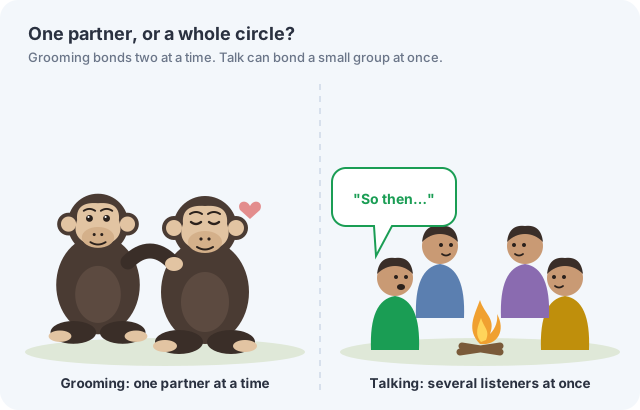
Talking instead of grooming
Monkeys and apes keep their friendships alive by grooming: picking through each other's fur, one partner at a time. It builds trust, but it takes hours. Some primates spend around a fifth of their day doing it, and there is a limit to how many relationships a day can hold.
The anthropologist Robin Dunbar proposed in the 1990s that language solved this problem. His "vocal grooming" hypothesis suggests that talk works like grooming at a distance: one speaker can keep several listeners engaged at once (Dunbar found that natural conversations tend to top out at about four people) while everyone's hands stay free for other work. That efficiency, he argued, let human groups grow to around 150 people, the figure now known as "Dunbar's number." It remains a hypothesis, and the exact number is debated, but the core idea is widely discussed: language is social glue as much as it is a way to pass on facts.
Working together to survive
Language also made cooperation far more precise. A hunting party can agree on a plan before it sets out. A group can discuss where to move when the seasons change, warn each other about a rival band, or explain which waterholes have dried up. Pointing and calling can do some of this; sentences can do much more, including talk about things that are far away, in the past or only planned.
Teaching is a striking example. In a 2015 experiment, volunteers learned to make simple stone tools of the kind our ancestors made about 2.6 million years ago. Those who were taught with spoken instructions learned far better than those who could only watch. Researchers argue that even basic toolmaking may have pushed our ancestors toward better communication.
A body and brain tuned for speech
Over hundreds of thousands of years, the human body changed in ways that made speech easier. Three changes stand out, and each is more interesting than the popular version.
The brain. In 1861 the French physician Paul Broca studied a patient who could understand speech but could barely speak, and traced the problem to a region of the left frontal lobe, now called Broca's area. In 1874 the German neurologist Carl Wernicke described patients with the opposite problem, fluent but meaningless speech, linked to a region further back, now Wernicke's area. Modern brain imaging shows that language actually draws on a much wider network, but these two areas remain the classic landmarks.
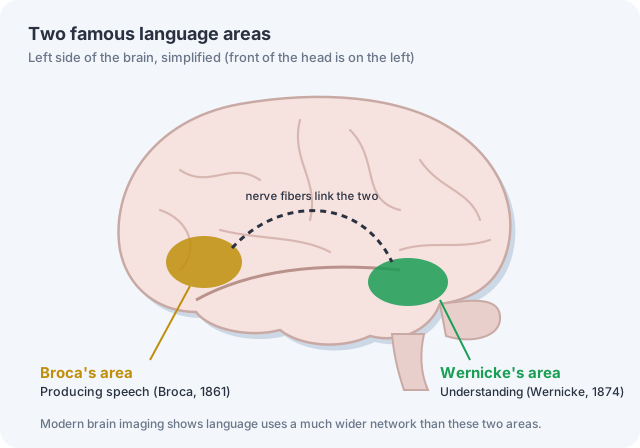
The voice box. It is often said that humans can talk because our larynx sits unusually low in the throat. Newer research complicates that story. Other animals, from deer to lions, can lower the larynx too, and studies of monkey vocal tracts suggest they could produce more vowel-like sounds than once thought. In 2022 researchers studying 43 primate species found a different difference: other primates have thin "vocal membranes" next to their vocal folds that humans have lost. That loss gave us a steadier, more controllable voice. The bigger change was in the brain's fine control over the voice, not just its shape.
The genes. The gene FOXP2 became famous after a British family with a mutation in it was found to have serious difficulty controlling the mouth movements needed for speech. It is clearly important. But it is not "the language gene," and the human version is not as unique as once thought.
Not quite. Neanderthals carried the same version of FOXP2 as modern humans, and a 2018 study of diverse human genomes found no evidence of the recent "selective sweep" once claimed for it. Language depends on many genes working together, and FOXP2 is one of them.
Knowledge that outlives its owner
Before language, a clever discovery could easily die with whoever made it, unless someone happened to watch closely and copy it. Language changed that. Parents could explain which plants were safe, which were medicine and which were poison, how a predator behaves, or where to find water in a drought. Stories and songs packed that knowledge into a form people could remember. Each generation could start from where the last one stopped, an effect researchers call the cultural "ratchet."
But spoken knowledge has a ceiling. It lives only in memory, it changes a little with every retelling, and it is lost if the people who hold it die before passing it on.
Writing: memory outside the head
The psychologist Merlin Donald called written records "exograms": memories stored outside the brain. Unlike a human memory, a written record doesn't fade or drift. It can be checked, copied and read by people who never met its author. That is the real revolution of writing, and it began with something unglamorous: bookkeeping.
It started with accounting
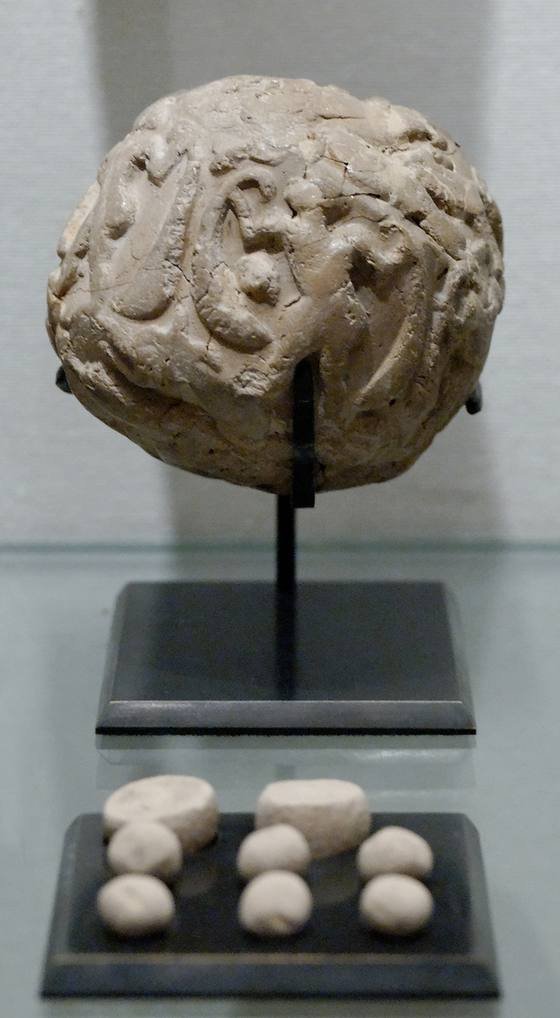
From about 8000 BCE, farming communities in the Near East used small clay tokens in different shapes to keep track of goods such as grain and animals. Later, tokens were sealed inside hollow clay balls, called bullae, as a kind of receipt. Because nobody could see inside without breaking the ball, people began pressing marks on the outside to show what it held. The archaeologist Denise Schmandt-Besserat argued that this is how the first written signs developed. Her theory is influential but not universally accepted.
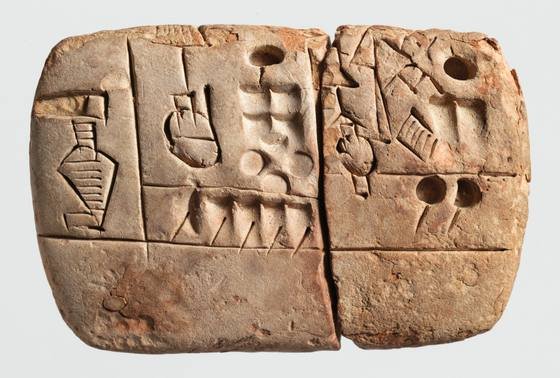
By about 3400–3100 BCE, scribes in the cities of southern Mesopotamia, such as Uruk, were writing on flat clay tablets. These earliest texts, called proto-cuneiform, are almost all administrative: rations, livestock, land and labor. As cities grew too large for everyone to know and trust each other, written records took over the job that memory and handshakes had done.
Invented more than once
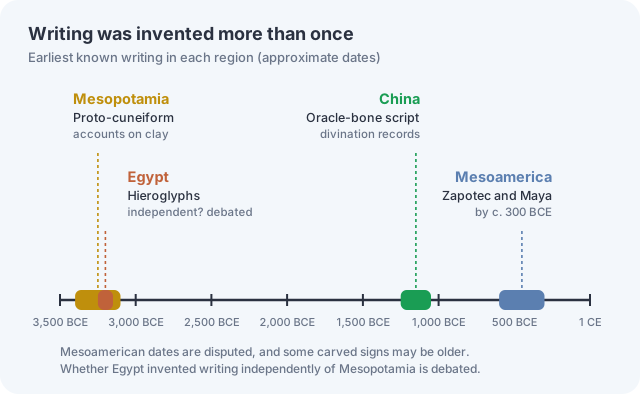
Writing was not a single invention that spread around the world. Scholars agree it was invented independently at least three times, and possibly four.
| Region | Earliest writing | Script | Early uses |
|---|---|---|---|
| Mesopotamia | c. 3400–3100 BCE | Proto-cuneiform, then cuneiform | Accounts, rations, lists |
| Egypt | c. 3250 BCE | Hieroglyphs | Labels for goods, royal names (independence debated) |
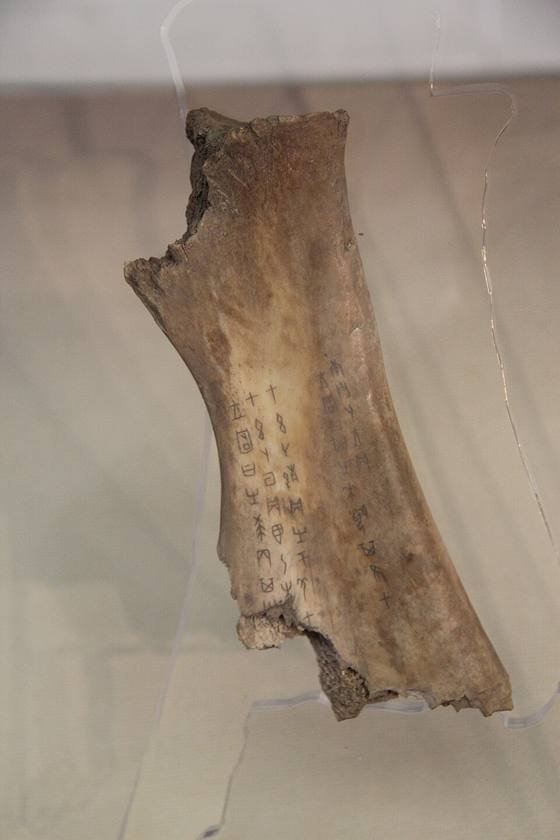
| China | c. 1250 BCE | Oracle-bone script | Questions to ancestors and gods |
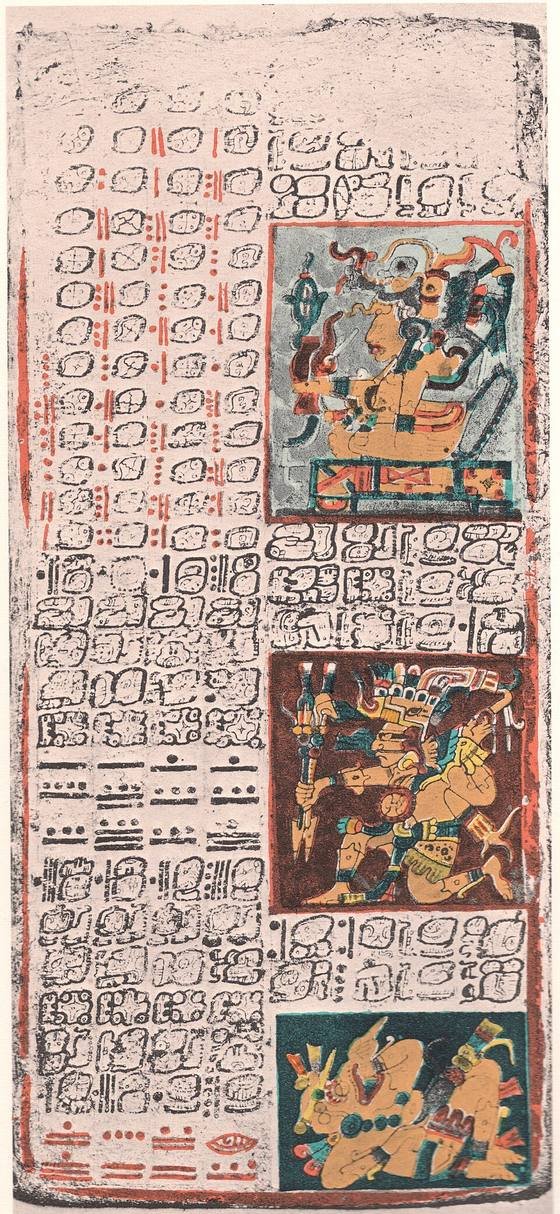
| Mesoamerica | by c. 300 BCE, possibly earlier | Zapotec, then Maya and others | Calendars, rulers, history |
Writing builds the state
Once rulers could write, they could govern places they never visited. Written orders, tax lists and census records let a central government collect grain, raise armies and run a bureaucracy across a whole region.
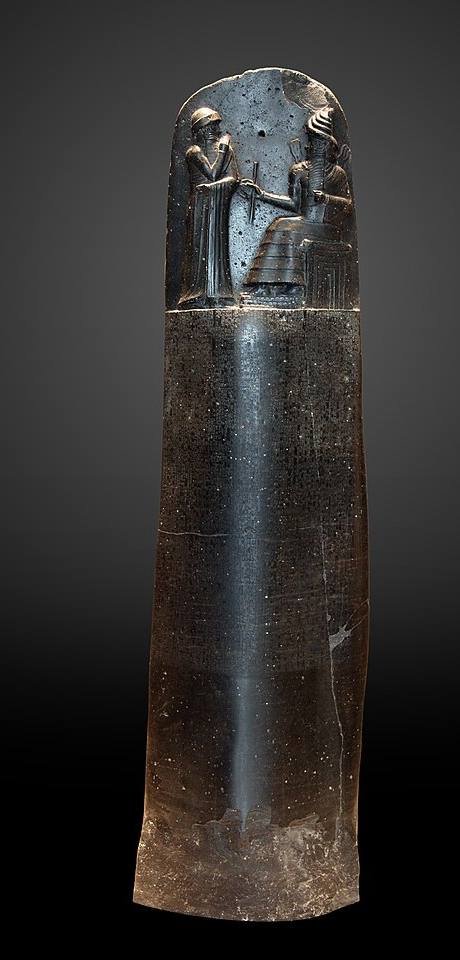
The most famous example is the Code of Hammurabi, set down around 1750 BCE by the Babylonian king Hammurabi. Its basalt stele, 2.25 meters tall, lists about 280 laws covering trade, property, family and punishment, below a carved scene of the king before the sun god Shamash. Interestingly, historians still debate how it was used. No surviving court record cites it, and many verdicts don't follow it, so it may have been a statement of royal justice and a model text for scribes rather than a rulebook that judges applied.
The alphabet opens the door
Early scripts were powerful but hard to learn. Cuneiform and Egyptian hieroglyphs used hundreds of signs, so writing stayed the work of trained scribes. Around 1800 BCE, Semitic-speaking workers in Egypt and the Sinai borrowed a few hieroglyph shapes and used each one for a single consonant sound. This Proto-Sinaitic script is the ancestor of nearly every alphabet in use today.
The Phoenicians, traders from the coast of today's Lebanon, refined it into a tidy set of 22 consonant letters by about 1050 BCE and carried it around the Mediterranean. Around 800 BCE the Greeks adapted it and added letters for vowels, and the Romans later developed the Latin alphabet you are reading now. Even the word "alphabet" comes from the first two Greek letters, alpha and beta.
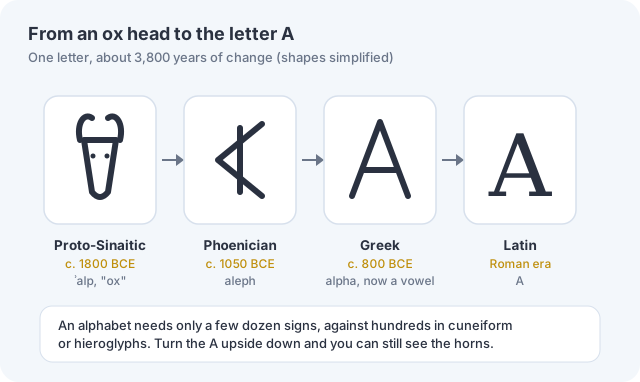
Fewer signs meant writing was easier to learn, though mass literacy took thousands of years more. For most of history, most people could not read.
From clay to cloud
The materials changed again and again, from clay and stone to papyrus, parchment and paper, and that story deserves its own article: From Stone to Screen: A 5,000-Year History of Writing. Printing with movable metal type, developed by Johannes Gutenberg around 1450, made copies cheap and identical. Today, digital text can be searched, copied and sent around the world in an instant. The tools changed, but the idea is the one the scribes of Uruk had: get the words out of your head and onto something that lasts.
Where speech meets the alphabet
The NATO phonetic alphabet turns written letters back into clear spoken words, so "A" becomes "Alfa." Spell any name or code aloud without mistakes with our free converter.
Open the NATO Phonetic Alphabet →Frequently asked questions
When did humans start speaking?
Nobody knows, because speech leaves no fossils. Estimates range from about 50,000 to several hundred thousand years ago, depending on which evidence researchers weigh most: anatomy, genes or signs of symbolic behavior.
What was the first writing system?
The oldest known writing is proto-cuneiform from southern Mesopotamia, about 3400–3100 BCE, used mainly for accounts. Egyptian hieroglyphs appeared soon after, around 3250 BCE.
Is FOXP2 the language gene?
No. FOXP2 helps control the movements needed for speech, but language depends on many genes. Neanderthals had the same version of FOXP2 as modern humans.
Where does the alphabet come from?
It began with the Proto-Sinaitic script around 1800 BCE, developed into the Phoenician alphabet, and was adapted by the Greeks, who added vowels. The Latin alphabet grew from the Greek one.